Love Nuclear
Drafted with AI assistance. Every factual claim was checked against primary sources in August 2026; the sources are listed at the end of this article.
Australia is the strangest country in the world on nuclear energy. It holds around a third of the world's recoverable uranium, mines and exports it to countries that run reactors, operates a research reactor in suburban Sydney that supplies a large share of the world's nuclear medicine — and prohibits nuclear power by federal law.
That contradiction is often described as a mystery. It isn't. Every part of it has a traceable cause, and most of those causes are political rather than technical. This article sets out what is actually in the way, in the order that matters, and tries to be accurate about the ones that have moved recently — because several have, and not all of them in the direction a nuclear advocate would like.
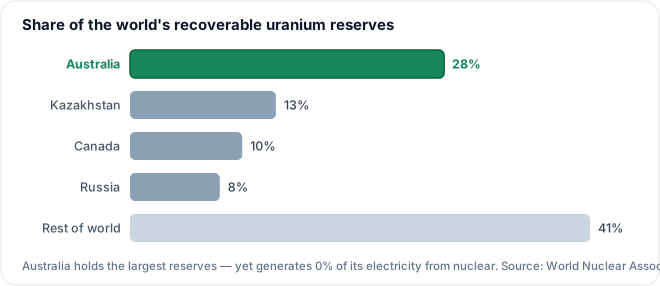
!Bar chart of uranium reserves by country
Australia holds the world's largest uranium reserves — and generates none of its own nuclear power.
Australia came closer to nuclear power than most people realise. In the late 1960s the Gorton government planned a 500 MW reactor at Jervis Bay on the New South Wales coast; tenders were called and a site was cleared. The project was shelved in 1971 on cost grounds, and quietly abandoned by the Whitlam government that followed. Australia's nuclear-free status is not the product of a considered national decision so much as of one cancelled project and fifty years of not revisiting it.
What filled that gap was the uranium debate of the 1970s. The Ranger Uranium Environmental Inquiry, chaired by Justice Russell Fox and universally known as the Fox Report, reported in two parts in 1976 and 1977. It is frequently misdescribed — including in earlier versions of this article — as having recommended that uranium mining proceed only if Australia forwent domestic nuclear power. It recommended nothing of the sort.
What the Fox Report actually concluded was that the hazards of mining and milling uranium could be managed under sufficiently strict regulation, and that mining at Ranger should be allowed to proceed on that basis. Alongside that, it recommended granting Aboriginal title over a substantial part of the region and creating what became Kakadu National Park. Its caution was directed at the international fuel cycle and weapons proliferation, not at Australian electricity generation. It is a more interesting document than the slogan version, and the slogan version has been repeated by both sides of the argument for forty years.
The prohibition itself came much later, and from an unexpected direction: it was the price of building a new research reactor. In 1998, legislating for the replacement of the ageing HIFAR reactor at Lucas Heights, the Howard government accepted amendments barring anything beyond it. The ban is a legislative artefact of a compromise, not the outcome of an inquiry.
This is worth stating precisely, because it is routinely reported loosely.
Section 10 of the Australian Radiation Protection and Nuclear Safety Act 1998 does not merely fail to authorise nuclear power. It expressly prohibits the Chief Executive Officer of ARPANSA from licensing the construction or operation of a nuclear fuel fabrication plant, a nuclear power plant, an enrichment plant or a reprocessing facility. It is an express prohibition, not a gap.
Section 140A of the Environment Protection and Biodiversity Conservation Act 1999 does the same job from the other direction, preventing the federal environment minister from approving any such action.
Two statutes, two express bans, both amendable by an ordinary Act of Parliament. There is no constitutional obstacle and no referendum required at the federal level. Repeal needs a majority in both houses and nothing more.
The states are the harder problem, and are usually overlooked. New South Wales (Uranium Mining and Nuclear Facilities Prohibitions Act 1986), Victoria (Nuclear Activities Prohibitions Act 1983) and Queensland (Nuclear Facilities Prohibition Act 2000) each independently prohibit nuclear facilities. Queensland's Act goes further: if the state minister is satisfied the Commonwealth has taken, or is likely to take, steps toward a prohibited nuclear facility in Queensland, the minister must arrange a state-wide plebiscite on it. A federal government that repealed both Commonwealth bans tomorrow would still face three state statutes and, in Queensland, a public vote.
Only South Australia and Western Australia lack such prohibitions — which is part of why proposals tend to gravitate toward South Australia, and why the Northern Territory and remote WA mining loads recur in SMR discussions.
Nuclear power has been a partisan marker in Australian politics for four decades, but the position of the parties has changed recently enough that older accounts are misleading.
In June 2024 the Coalition, under Peter Dutton, adopted a policy of building government-owned reactors at seven specific sites — Liddell and Mount Piper in NSW, Loy Yang in Victoria, Tarong and Callide in Queensland, Northern Power Station in South Australia, and Muja in Western Australia — all of them retiring or retired coal stations, chosen for their existing grid connections and cooling infrastructure.
Dutton described the May 2025 federal election as "a referendum on nuclear power." It is a description worth taking seriously, because the result was unambiguous. Labor was returned with 94 of 150 House seats against the Coalition's 43 — the Coalition's worst result since the Liberal Party was founded in 1944 — and Dutton became the first sitting opposition leader in Australian history to lose his own seat at a general election.
Honesty requires two things to be said about that. The first is that the election was fought on cost of living, interest rates and the shadow of a volatile Washington at least as much as on energy, and no serious analyst attributes the scale of the defeat to nuclear policy alone. The second is that it is nonetheless the clearest electoral verdict Australia has delivered on the question, and treating it as unrelated to the outcome would be wishful.
The more interesting fact sits alongside it, and cuts the other way.
For years this article, and much of the commentary it drew on, asserted that polling "consistently shows a majority of Australians oppose nuclear power."
That was true once and is no longer true. The Lowy Institute Poll — the source previously cited here for the opposite proposition — asked in 2024 whether Australians support or oppose using nuclear power to generate electricity alongside other sources. 61% said they support it; 37% opposed. Those who "strongly support" (27%) outnumbered those who "strongly oppose" (17%). The same organisation had asked a related question in 2011 and found 62% against.
That is close to a complete reversal in thirteen years, and it is the single most important fact in this article. Question wording matters — support drops when a poll names a specific site, a specific cost, or a specific timeframe, and "alongside other sources of energy" is a gentler frame than "instead of renewables". But the direction and the size of the shift are not artefacts of wording.
So the honest summary is uncomfortable for both camps. A clear majority of Australians are open to nuclear power in principle; a clear majority of Australians voted, months later, for a party opposing it. Those two facts coexist because in-principle openness is not the same as a voting priority, and because a policy is judged on its specifics — cost, sites, timing, who pays — rather than on the technology in the abstract.
The practical implication for anyone trying to change minds: the argument that nuclear is safe is largely won. The arguments still live are about cost and about time.
Any serious Australian discussion of nuclear economics has to engage with GenCost, the annual costing report produced by the CSIRO with the Australian Energy Market Operator. It is the reference document, it is cited by government, and it is not favourable.
GenCost's recent editions find that large-scale nuclear costs less per unit than small modular reactors but that both remain moderate-to-high-cost sources for Australia, and — using its system-level method, which accounts for the storage, transmission and firming that variable renewables require — that neither is competitive against a mix of solar, onshore wind, storage and gas or hydrogen.
There are real criticisms of GenCost, and they are worth understanding rather than dismissing. It assumes a first-of-a-kind Australian build with no established supply chain or workforce, which is the most expensive possible case. It has used an economic life shorter than the 60-to-80-year operating licences regulators now issue, which spreads capital cost over fewer years. And its system-cost modelling embeds assumptions about achievable storage costs and transmission build rates that are themselves forecasts.
But the criticisms do not currently overturn the conclusion, and pretending otherwise is not a good use of anyone's time. The stronger version of the pro-nuclear argument in Australia is not that GenCost is wrong about the cost of a first reactor. It is that:
Other structural obstacles are real. The National Electricity Market's short-horizon price signals suit low-capital, flexible plant, not high-capital plant with a forty-year payback. Australia's grids are small and comparatively isolated, and a single 1,100 MW unit is a large fraction of some state loads — one of the more substantive arguments for SMRs here, though SMRs currently cost more per kilowatt, not less. And Australia has no nuclear supply chain, no commercial nuclear workforce and no commercial reactor regulator; ARPANSA regulates research reactors and medical radiation, and would need a materially different capability.
Australia already produces radioactive waste — from the OPAL reactor at Lucas Heights, from nuclear medicine, from industry and research — and stores it at more than a hundred locations around the country.
It does not have, and is not currently building, a national disposal facility. The plan to build one at Napandee near Kimba in South Australia was quashed by the Federal Court in July 2023, on the ground that the minister's decision was affected by apprehended bias, following a challenge by Barngarla Traditional Owners who had been excluded from the community ballot and who voted 83–0 against in their own survey. The government abandoned the site in August 2023. Earlier versions of this article said a facility was "being developed". None is.
That episode is genuinely instructive, and not only as a failure. Finland and Sweden sited their repositories successfully by making consent the mechanism rather than an obstacle — communities volunteered, could withdraw, and were given a real veto. Canada took twelve years and, in November 2024, selected a site in northwestern Ontario with the agreement of both the Township of Ignace and Wabigoon Lake Ojibway Nation. Kimba failed on precisely the point those succeeded on. Any Australian nuclear programme would need to solve this, and the lesson from abroad is that it is solvable, but only by doing consent properly rather than procedurally.
Weapons testing. British nuclear weapons were tested at Maralinga, Emu Field and the Montebello Islands through the 1950s and early 1960s, on and near the lands of Anangu people who were inadequately warned, inadequately evacuated and inadequately compensated, and the clean-up was botched and repeated. This is not a misconception to be corrected. It is a real thing the Australian and British governments did, and it is the deepest root of Australian nuclear distrust — particularly among Aboriginal communities, and particularly in South Australia, where nuclear proposals most often land. Any advocacy that treats this as ignorance to be educated away will fail, and will deserve to.
Environmental identity. Australians tend to define national identity partly through landscape, and nuclear power has been framed for fifty years as its opposite. The framing is beatable — the land-use argument is strongly in nuclear's favour — but it is a framing contest, not a fact deficit.
Rural–urban asymmetry. Reactors would be built in regional communities; the political weight sits in capital cities. The seven sites named in 2024 are all existing coal towns, which is deliberate: those are the communities that already live with a power station, already have the workforce, and stand to lose the most from closure without replacement. They are also the communities most often talked about rather than to.
Unfamiliarity. Most Australians have never seen a reactor. Lucas Heights is the exception and is underused as an argument: a research reactor has operated in suburban Sydney since 1958, about 30 km from the CBD, supplying nuclear medicine to the region, and the overwhelming majority of Sydneysiders have never had cause to think about it.
AUKUS. Australia is acquiring nuclear-powered submarines, and in doing so has built the beginnings of a domestic nuclear regulatory state. The Australian Naval Nuclear Power Safety Act 2024 created the Australian Naval Nuclear Power Safety Regulator, an independent body with designated zones at HMAS Stirling in Western Australia and Osborne in South Australia. That is a nuclear safety regulator, nuclear-qualified personnel, and public familiarity with reactors operating in Australian waters — none of which existed five years ago.
Two caveats matter. The Act deals with naval propulsion and does not touch the civil prohibitions; nothing in it makes a power reactor lawful. And the submarine programme itself has become less certain rather than more: following a US review, the arrangement was revised in 2026 so that Australia will take three second-hand Virginia-class boats rather than a mix of new and used, reflecting American shipyard capacity, with correspondingly less reactor life remaining. AUKUS is a genuine change in Australia's nuclear circumstances; it is not a reliable argument that large nuclear projects run to plan.
Public opinion, discussed above, which has moved further than any other variable.
Coal retirement. Australia's coal fleet is old and closing on a published schedule. Whatever replaces it has to be decided this decade, which converts an abstract argument into a dated one.
Industrial load. Green iron, ammonia, aluminium and critical-minerals processing need enormous quantities of reliable heat and power. This is the part of the decarbonisation problem that variable renewables address least comfortably, and it is where the Australian nuclear argument is strongest.
In rough order:
Almost every barrier above has a version that says a country starting from nothing cannot do this. No workforce, no regulator, no supply chain, no institutional memory. The United Arab Emirates is the strongest evidence against that claim, and it is worth being precise about what it does and does not prove.
In 2008 the UAE had no civil nuclear industry: no power reactor, no reactor operators, no nuclear regulator. That year it published a national policy on the peaceful use of nuclear energy. In 2009 it built the two institutions the policy required — the Federal Authority for Nuclear Regulation as an independent regulator, and the Emirates Nuclear Energy Corporation to develop and own the plant — and signed a civil nuclear cooperation agreement with the United States [9]. In December of that year it awarded the prime contract, reported at around US$20 billion, to a consortium led by the Korea Electric Power Corporation for four APR-1400 reactors.
Construction began in July 2012. FANR issued the Unit 1 operating licence in February 2020; the unit started up on 1 August 2020 and was connected to the grid eighteen days later [9]. Unit 1 entered commercial operation in April 2021, Unit 2 in March 2022, Unit 3 in February 2023, and Unit 4 in September 2024 [10]. Barakah now runs four APR-1400s totalling roughly 5,600 MW and supplies about a quarter of the UAE's electricity [9].
Twelve years from a policy document to first power. Sixteen to a finished four-unit station.
The delay is the most useful part of the story. Unit 1 was originally scheduled to enter commercial operation in 2017 and did so in April 2021 — about four years late. The reason given was not construction. Nawah, the operating subsidiary, said the revised schedule reflected the time needed to complete operator training and secure regulatory approvals [11]. The reactor was finished well before the people licensed to run it were.
That is the specific lesson for Australia, and it is why item 3 above notes that building a regulator can start before anything else is settled. It is the long pole, it is not on the critical path of any construction contract, and a country that waits until it has legislated to begin will find the schedule waiting for it rather than the other way round.
What the UAE had that Australia does not. Honesty about this matters, because the example is often deployed as though it were a shortcut, and it is not one.
Barakah was bought, not developed: a fixed-price turnkey order from an experienced vendor, with no attempt to build domestic reactor technology or a local supply chain. The expertise was imported first and localised afterwards — the regulator and the operator were staffed internationally at the outset, with Emiratisation following over the subsequent decade rather than preceding the build. Decisions were taken by a single federal government with sovereign funding, unconstrained by state prohibitions, an electricity market bidding on short price signals, or an election cycle. The site is an unpopulated stretch of coast in Al Dhafra, roughly 53 km from the nearest town [9], with none of the planning objections or native title questions an Australian siting process would properly involve. The UAE also gave up something Australia might not want to: its agreement with the United States renounced domestic enrichment and reprocessing.
So the UAE does not show that Australia could do this quickly, and anyone citing it as proof that the barriers are soft is overreading it. It shows something narrower and more useful: the absence of an existing nuclear industry is not, by itself, the barrier. Regulators, operators and trained workforces can be built roughly within a decade by a country that decides to build them and pays for it. What Barakah cannot tell Australia is how to do that through a federation, a competitive electricity market, and a parliament — which is where the real difficulty in this article lies.
The barriers to nuclear power in Australia are substantial. But they are not, mostly, the ones the debate spends its time on.
Public fear is no longer the main obstacle: a clear majority of Australians now say they are open to nuclear power, a reversal from a decade ago. Safety is not the main obstacle either; that argument has largely been won on the evidence.
What remains is harder and more mundane. Two federal statutes and three state ones. No regulator. No workforce. No supply chain. No waste facility, and a recent failed attempt at one that a court found procedurally tainted. A market structure that punishes long-payback capital. A cost estimate from the national science agency that says the numbers don't work, whose assumptions are arguable but not yet overturned. And an electorate that is open to the idea in principle and has just voted decisively against a specific version of it.
None of that is insurmountable. All of it is slow. Finland, Canada and South Korea got there through decades of institution-building, genuine community consent, and repeated builds rather than one-offs. The UAE did it faster — sixteen years from a blank sheet to four operating reactors — but by buying the technology outright, importing the expertise, and deciding it in a way a federation with an electricity market cannot. Australia has done none of that groundwork, on either model, and no amount of enthusiasm substitutes for it.
The honest case for nuclear power in Australia is not that it is cheap today or that the barriers are illusory. It is that a country with the world's largest uranium reserves, a sixty-year-old research reactor in a capital city, a closing coal fleet, an industrial base that needs firm power, and a brand-new naval nuclear regulator should probably not have a law on its books forbidding anyone from even applying.
[1] Geoscience Australia, "Uranium" (Australian Resource Reviews). https://www.ga.gov.au/scientific-topics/minerals/mineral-resources-and-advice/australian-resource-reviews · OECD Nuclear Energy Agency and IAEA, Uranium: Resources, Production and Demand ("the Red Book"). https://www.oecd-nea.org/jcms/pl_95044/uranium-2022-resources-production-and-demand
[2] Australian Radiation Protection and Nuclear Safety Act 1998 (Cth), s 10. https://www.legislation.gov.au/C2004A00354/latest/text · Environment Protection and Biodiversity Conservation Act 1999 (Cth), s 140A. https://www.legislation.gov.au/C2004A00485/latest/text
[3] Lowy Institute Poll 2024, "Nuclear energy" — 61% support, 37% oppose. https://poll.lowyinstitute.org/charts/australia-using-nuclear-power-to-generate-energy/
[4] Ranger Uranium Environmental Inquiry (Fox Report), First Report (1976) and Second Report (1977). https://www.dcceew.gov.au/science-research/supervising-scientist/publications/ranger-uranium-environmental-inquiry-report-final
[5] CSIRO and AEMO, GenCost: cost of building Australia's future electricity needs, annual. https://www.csiro.au/en/research/technology-space/energy/electricity-transition/gencost
[6] Nuclear Facilities Prohibition Act 2000 (Qld), including the plebiscite requirement. https://www.legislation.qld.gov.au/view/html/inforce/current/act-2000-063 · Nuclear Activities (Prohibitions) Act 1983 (Vic) · Uranium Mining and Nuclear Facilities (Prohibitions) Act 1986 (NSW)
[7] Department of Industry, Science and Resources, "National Radioactive Waste Management Facility: Federal Court decision" (2023). https://www.industry.gov.au/news/national-radioactive-waste-management-facility-federal-court-decision
[8] Australian Naval Nuclear Power Safety Act 2024 (Cth). https://www.legislation.gov.au/C2024A00091/latest/text · Australian Naval Nuclear Power Safety Regulator. https://www.annpsr.gov.au/
[9] Government of the United Arab Emirates, "Nuclear energy" (official UAE government platform) — 2008 policy, FANR and ENEC established 2009, US cooperation agreement 2009, construction commenced July 2012, Unit 1 operating licence 17 February 2020, start-up 1 August 2020, grid connection 19 August 2020, Barakah site location, and about 25% of national electricity when all four units run. https://u.ae/en/information-and-services/environment-and-energy/water-and-energy/types-of-energy-sources/nuclear-energy · Federal Authority for Nuclear Regulation. https://www.fanr.gov.ae/en
[10] Emirates Nuclear Energy Corporation, "UAE celebrates historic milestone as Unit 4 of the Barakah plant commences commercial operation" (September 2024). https://www.enec.gov.ae/news/latest-news/uae-celebrates-historic-milestone-as-unit-4-of-the-barakah-plant-commences-commercial-operation/
[11] World Nuclear News, "Barakah 1 start-up schedule revised for operator training" — Nawah Energy Company attributing the revised schedule to operator training and regulatory approvals. https://www.world-nuclear-news.org/Articles/Barakah-1-start-up-schedule-revised-for-operator-t