Understanding the Science Behind Clean Power
Love Nuclear
Drafted with AI assistance. Every factual claim was checked against primary sources in August 2026; the sources are listed at the end of this article.
Nuclear energy represents one of humanity's most remarkable scientific achievements, harnessing the fundamental forces that power the stars to generate clean electricity here on Earth. Despite decades of safe operation and technological advancement, many people remain unfamiliar with how nuclear power actually works. This comprehensive guide will demystify nuclear energy, explaining the science, technology, and processes that make nuclear power plants among the most reliable and clean sources of electricity available today.
To understand nuclear energy, we must first understand the basic building blocks of matter. Every element in the universe is composed of atoms, which consist of a dense central nucleus surrounded by orbiting electrons [1]. The nucleus itself contains two types of particles: protons, which carry a positive electrical charge, and neutrons, which carry no charge. The number of protons in an atom's nucleus determines what element it is, while the total number of protons and neutrons determines the atom's mass.
Nuclear energy originates from the tremendous forces that hold the nucleus together. These nuclear forces are incredibly powerful—millions of times stronger than the chemical bonds that hold molecules together. When certain heavy atomic nuclei are split apart or when light nuclei are fused together, a small amount of matter is converted directly into energy according to Einstein's famous equation E=mc². Because the speed of light (c) is such a large number, even a tiny amount of matter (m) can be converted into an enormous amount of energy (E).
This principle explains why nuclear energy is so incredibly dense compared to other energy sources. A single uranium fuel pellet the size of a fingertip contains as much energy as a ton of coal [1]. This extraordinary energy density is what makes nuclear power both so powerful and so efficient in terms of fuel requirements and waste production.
Uranium is a naturally occurring metal found in rocks throughout the world, making it more abundant than gold, silver, or mercury [1]. However, not all uranium is suitable for nuclear power generation. Natural uranium consists primarily of two isotopes: uranium-238, which makes up about 99.3% of natural uranium, and uranium-235, which comprises less than 1% but is the key to nuclear fission.
Uranium-235 is special because it is "fissile," meaning its nucleus can be easily split when struck by a neutron. Uranium-238, while much more abundant, cannot sustain a nuclear chain reaction on its own. This is why most nuclear power plants use "enriched" uranium, where the concentration of uranium-235 has been increased from its natural level of 0.7% to about 3-5% [1].
The enrichment process is a sophisticated technological achievement that separates uranium isotopes based on their tiny difference in mass. The most common method today uses gas centrifuges that spin at tremendous speeds, gradually concentrating the lighter uranium-235 isotopes. This enriched uranium is then formed into ceramic pellets and loaded into long metal tubes called fuel rods, which are bundled together to create fuel assemblies for nuclear reactors.
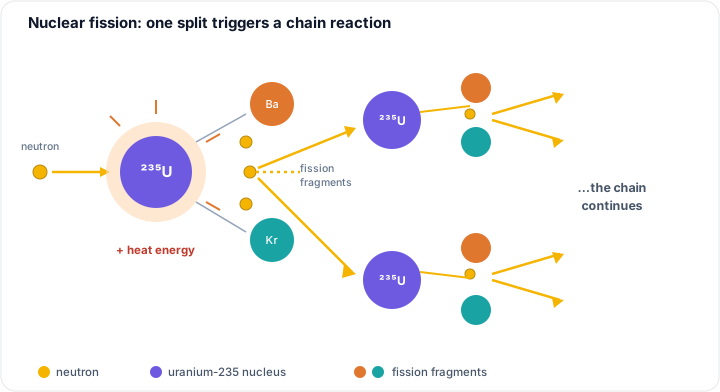
!Diagram of a nuclear fission chain reaction
One neutron splits a uranium-235 nucleus, releasing energy and 2–3 more neutrons — which split more nuclei.
Nuclear fission is the process that powers all commercial nuclear reactors currently in operation. When a neutron strikes the nucleus of a uranium-235 atom, the nucleus becomes unstable and splits into two smaller nuclei, typically barium and krypton, along with two or three additional neutrons and a tremendous amount of energy [1].
The energy released in this process comes in several forms. Most of it appears as kinetic energy of the fission fragments—the smaller nuclei that result from the split. These fragments move at extremely high speeds, quickly colliding with surrounding atoms and converting their kinetic energy into heat. A smaller portion of the energy is released as gamma radiation and the kinetic energy of the released neutrons.
The key to sustaining nuclear power generation is the chain reaction. The neutrons released from one fission event can strike other uranium-235 nuclei, causing them to split and release more neutrons, which can then cause additional fissions. In a nuclear reactor, this chain reaction is carefully controlled to maintain a steady rate of fission events, producing a constant output of heat energy.
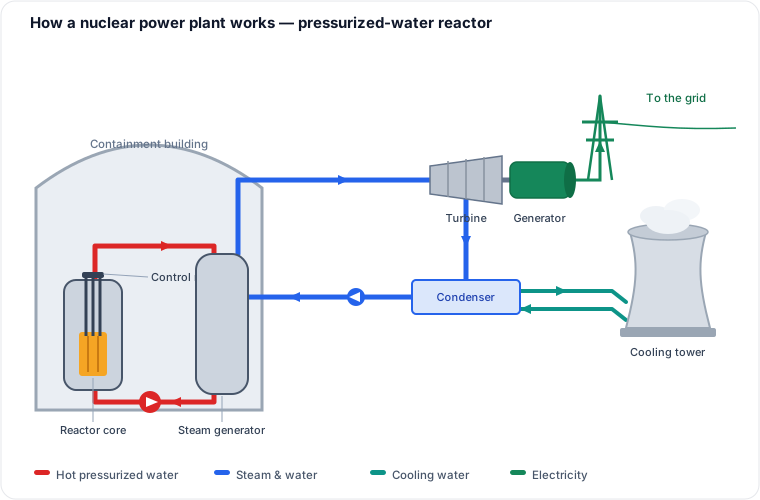
How a pressurized-water reactor turns fission heat into electricity.
The process of converting nuclear fission into electricity is remarkably similar to how fossil fuel power plants operate, with one crucial difference: the heat source. Instead of burning coal, oil, or gas, nuclear plants use the heat generated by controlled nuclear fission to produce steam, which then drives turbines connected to electrical generators [1].
In a typical pressurized water reactor (PWR), the most common type of nuclear plant, the reactor core contains hundreds of fuel assemblies submerged in water. The water serves multiple critical functions: it moderates the neutrons (slows them down so they're more likely to cause fission), it removes heat from the fuel, and it provides a safety mechanism since the nuclear reaction slows down if the water is lost.
The reactor operates within a massive steel pressure vessel, which is itself contained within a thick concrete containment structure designed to prevent any release of radioactive materials. The heat generated by fission is carried away by water circulating through the reactor core in what's called the primary loop. This highly pressurized water (about 150 times atmospheric pressure) prevents it from boiling despite temperatures reaching over 300°C.
The heated water from the primary loop passes through steam generators, where it transfers its heat to a separate water circuit called the secondary loop. The water in the secondary loop turns to steam, which drives turbines connected to electrical generators. After passing through the turbines, the steam is condensed back to water and the cycle repeats. This design ensures that the water that comes into direct contact with the nuclear fuel never leaves the containment structure, providing an additional layer of safety.
While the basic principle of nuclear fission remains the same, engineers have developed several different reactor designs, each with its own advantages and characteristics. Understanding these different types helps illustrate the versatility and safety features of modern nuclear technology.
Pressurized Water Reactors (PWRs) are by far the most common type worldwide, accounting for roughly 70% of the world's power reactors [2]. As described above, PWRs use ordinary water as both coolant and neutron moderator, with the reactor water kept under high pressure to prevent boiling. The two-loop design (primary and secondary) provides excellent safety characteristics and has proven highly reliable over decades of operation.
Boiling Water Reactors (BWRs) represent about 20% of global nuclear capacity. In BWRs, the water in the reactor core is allowed to boil, creating steam that directly drives the turbines. This single-loop design is somewhat simpler than PWRs but requires more sophisticated systems to ensure that any radioactive materials in the steam are contained and filtered.
Heavy Water Reactors, used primarily in Canada and India, use "heavy water" (deuterium oxide) as both coolant and moderator. Heavy water is more efficient at slowing down neutrons than ordinary water, allowing these reactors to use natural uranium without enrichment. This design provides greater fuel flexibility and efficiency in neutron utilisation.
Fast Breeder Reactors represent an advanced technology that can actually create more fuel than they consume. These reactors use fast neutrons (not slowed down by a moderator) to convert uranium-238 into plutonium-239, which is also fissile. While technically complex, breeder reactors could potentially extend uranium resources for thousands of years.
Nuclear power plants incorporate multiple, redundant safety systems based on the principle of "defence in depth." This approach creates several independent barriers between radioactive materials and the environment, ensuring that even if one or more systems fail, public safety is maintained [2].
The first barrier is the fuel itself. Uranium dioxide fuel is ceramic, with a very high melting point and low solubility in water. Most radioactive fission products remain trapped within the fuel pellets even under extreme conditions. The second barrier consists of the zirconium alloy cladding that surrounds each fuel pellet, designed to contain fission products under normal and accident conditions.
The third barrier is the reactor pressure vessel, a massive steel structure with walls several inches thick that contains the reactor core and primary cooling system. The fourth and most visible barrier is the containment structure, typically a reinforced concrete building with walls several feet thick, designed to withstand extreme events including aircraft impacts, earthquakes, and internal pressure from potential accidents.
Beyond these physical barriers, nuclear plants employ multiple active safety systems. Emergency core cooling systems can inject water into the reactor core if normal cooling is lost. Backup power systems, including diesel generators and battery banks, ensure that safety systems remain operational even during extended power outages. Control rod systems can rapidly shut down the nuclear reaction, with the rods designed to automatically insert into the core if power is lost or other emergency conditions occur.
Modern reactor designs incorporate even more advanced safety features, including passive safety systems that operate without electrical power or human intervention, relying instead on natural forces like gravity and convection to maintain safety functions.
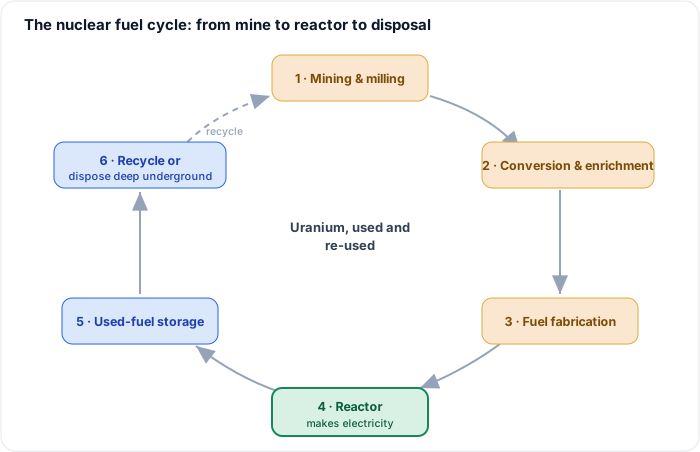
The journey of uranium from mine to reactor to disposal or recycling.
Understanding nuclear energy requires appreciating the complete fuel cycle, from uranium mining through final disposal of used fuel. This cycle demonstrates both the efficiency of nuclear fuel and the careful management required to handle radioactive materials safely.
The fuel cycle begins with uranium mining, which can be accomplished through conventional underground or open-pit mining, or through in-situ leaching, where solutions are pumped into underground uranium deposits to dissolve the uranium for extraction. Modern uranium mining operations are highly regulated and employ sophisticated environmental protection measures.
After mining, uranium ore is processed at mills to produce uranium concentrate, often called "yellowcake" due to its colour. This concentrate is then converted to uranium hexafluoride gas for the enrichment process. Following enrichment, the uranium is converted to uranium dioxide powder, formed into pellets, and loaded into fuel rods.
Nuclear fuel operates in a reactor for three to five years. Over that time roughly 70% of its uranium-235 is consumed — but because U-235 was only 3-5% of the fuel to begin with, only about 4-5% of the total heavy metal actually fissions [1]. (This is the number most often stated backwards: it is not that 3-5% of the U-235 is used, but that fission consumes 3-5% of the fuel mass.) What comes out still contains around 95% of its original uranium, mostly the U-238 that was never fissile, plus plutonium and other elements created during operation. This used fuel is highly radioactive and generates significant heat, requiring careful handling and storage.
Initially, used fuel is stored in specially designed pools of water at the reactor site. The water provides both cooling and radiation shielding. After several years, when the heat and radioactivity have decreased substantially, the fuel can be moved to dry storage in robust concrete and steel containers designed to safely contain the materials for decades.
Nuclear power currently provides about 9% of the world's electricity and about 19% of electricity in the United States [3]. In some countries it does much more: France generates about 68% of its electricity from nuclear, down from a peak above 75% and having dipped to ~63% in 2022 during a fleet-wide corrosion inspection programme. Slovakia, Ukraine, Belgium and Hungary all rely on nuclear for 40-60% of their electricity.
Nuclear plants are particularly valuable for providing "baseload" electricity—the steady, reliable power that forms the foundation of the electrical grid. Unlike solar and wind power, which depend on weather conditions, nuclear plants can operate at full capacity 24 hours a day, 365 days a year. In the United States, nuclear plants typically operate at over 90% capacity factor, meaning they generate electricity more than 90% of the time they're available to operate [3].
This reliability makes nuclear power an ideal complement to variable renewable energy sources. As electrical grids incorporate more solar and wind power, nuclear energy can provide the steady, controllable generation needed to balance supply and demand when the sun isn't shining or the wind isn't blowing.
Nuclear power plants require substantial upfront capital investment but offer very low operating costs once built. Fuel is a small share of nuclear's cost — around 20% of the levelised cost of the electricity, against 60-80% for a gas plant [3]. This means that nuclear electricity costs are largely independent of fuel price fluctuations, providing long-term price stability.
The high initial costs reflect the sophisticated engineering, extensive safety systems, and rigorous regulatory oversight required for nuclear plants. However, nuclear plants typically operate for 60 years or more, spreading these costs over many decades of electricity generation. Many nuclear plants have received license extensions to operate for 80 years, and some may be able to operate even longer with proper maintenance and upgrades.
When all costs are considered, including construction, operation, maintenance, and eventual decommissioning, nuclear power remains competitive with other forms of electricity generation, particularly when the environmental and health benefits of clean electricity are factored in.
Nuclear technology continues to evolve, with new reactor designs promising even greater safety, efficiency, and versatility. Small Modular Reactors (SMRs) are being developed to provide nuclear power in smaller, more flexible packages that could serve smaller communities or industrial applications. These reactors incorporate advanced safety features and could be manufactured in factories and shipped to sites, potentially reducing costs and construction time.
Advanced reactor designs under development include high-temperature gas reactors that could provide both electricity and industrial process heat, molten salt reactors that could burn existing nuclear waste as fuel, and fast reactors that could dramatically extend uranium resources. These technologies represent the next generation of nuclear power, building on decades of safe operation and continuous improvement.
Nuclear energy represents a mature, proven technology that has safely generated clean electricity for over six decades. The basic science of nuclear fission, while complex, is well understood and has been successfully harnessed in hundreds of reactors worldwide. The multiple safety systems, robust engineering, and careful regulatory oversight that characterize modern nuclear plants have created an outstanding safety record that continues to improve with each new generation of technology.
As the world seeks to address climate change while meeting growing energy demands, nuclear power offers a unique combination of reliability, cleanliness, and scalability that makes it an indispensable part of a sustainable energy future. Understanding the basics of how nuclear energy works—from the splitting of atoms to the generation of electricity—provides the foundation for appreciating why nuclear power deserves a central role in our clean energy transition.
The science is clear, the technology is proven, and the benefits are substantial. Nuclear energy isn't just part of our energy past—it's a crucial component of our clean energy future.
[1] International Atomic Energy Agency. "What is Nuclear Energy? The Science of Nuclear Power." November 15, 2022. https://www.iaea.org/newscenter/news/what-is-nuclear-energy-the-science-of-nuclear-power
[2] International Atomic Energy Agency. Power Reactor Information System (PRIS), reactor type statistics. https://pris.iaea.org/PRIS/WorldStatistics/OperationalReactorsByType.aspx
[3] U.S. Energy Information Administration, "Nuclear explained" (https://www.eia.gov/energyexplained/nuclear/) for generation shares; OECD Nuclear Energy Agency / IEA, Projected Costs of Generating Electricity 2020 (https://www.oecd-nea.org/jcms/pl_51110/projected-costs-of-generating-electricity-2020) for the fuel-share-of-cost comparison.