Separating Facts from Fear
Love Nuclear
Drafted with AI assistance. Every factual claim was checked against primary sources in August 2026; the sources are listed at the end of this article.
Nuclear power safety is one of the most misunderstood topics in modern energy discussions. Despite decades of safe operation and an outstanding safety record, public perception of nuclear power is often shaped by fear rather than facts. This comprehensive examination of nuclear safety reveals the truth: modern nuclear power is one of the safest forms of electricity generation ever developed, with multiple layers of protection and a track record that continues to improve with each passing year.
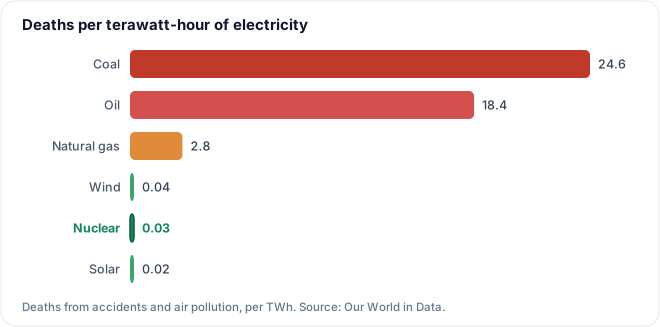
!Bar chart of deaths per terawatt-hour by energy source
Counting accidents and air pollution, nuclear is among the safest sources ever measured.
The numbers tell a compelling story about nuclear safety. In over 18,500 cumulative reactor-years of commercial nuclear power operation across 36 countries, there have been only two major accidents: Chernobyl in 1986 and Fukushima Daiichi in 2011 [1]. This represents an extraordinary safety record for any industrial technology, particularly one that has provided trillions of kilowatt-hours of electricity over six decades.
To put this in perspective, the aviation industry, which is widely considered very safe, experiences accidents every year that are meticulously analysed to improve safety. The chemical and oil-gas industries also experience major accidents that lead to improved safety practices. Yet nuclear power, despite its high energy density and the obvious potential hazards, has maintained a safety record that is unmatched by virtually any other industrial activity.
When we examine deaths per unit of energy generated, nuclear power consistently ranks as one of the safest energy sources. According to comprehensive analyses, nuclear power causes about 0.03 deaths per terawatt-hour of electricity generated — the same band as solar at 0.02 and wind at 0.04, and dramatically lower than anything burned [1]. Coal, by comparison, causes approximately 24.6 deaths per terawatt-hour, several hundred times more.
These statistics include all deaths attributable to nuclear power, including those from the Chernobyl and Fukushima accidents, mining and fuel processing activities, and occupational accidents during plant construction and operation. Even with these major accidents included, nuclear power's safety record remains exceptional.
To understand nuclear safety, we must examine the few serious accidents that have occurred and learn from them. Each major nuclear accident has led to significant improvements in reactor design, safety systems, and operational procedures.
Three Mile Island (1979) was the most serious nuclear accident in U.S. history, yet it resulted in no injuries or deaths and no significant radiation exposure to the public [1]. The accident occurred when a combination of equipment failures and operator errors led to a partial meltdown of the reactor core. However, the containment structure performed as designed, preventing any significant release of radioactive materials. The accident led to major improvements in reactor design, operator training, and emergency procedures that have made nuclear plants even safer.
Chernobyl (1986) was the most serious nuclear accident in history, and it involved a reactor design fundamentally unlike anything operated in the West. The RBMK had no containment building, and its core produced more power as its coolant boiled away — a strongly positive void coefficient. Western light-water reactors are the opposite on both counts: the water is the moderator as well as the coolant, so losing it stops the reaction, and the whole reactor sits inside a steel-and-concrete containment building [1].
The immediate toll was two deaths in the explosion and 28 more from acute radiation sickness within three months, almost all of them firefighters and plant staff.
The accident's principal documented health consequence, however, was not among those workers. UNSCEAR has recorded roughly 19,000 cases of thyroid cancer among people who were children or adolescents in the affected areas in 1986, a substantial share of them attributable to the accident [2]. They were caused by radioactive iodine concentrating in the thyroid — overwhelmingly through contaminated milk that Soviet authorities did not withdraw from sale, in a population that was iodine-deficient to begin with. Thyroid cancer is highly survivable when treated: around 15 of those cases have proved fatal.
It is worth stating this rather than omitting it, for two reasons. The first is that it is true and easily found. The second is that the cause was a government concealing an accident from the people living in it, not a property of nuclear energy — and every measure that would have prevented it (announce, distribute iodine tablets, stop the milk) is standard practice everywhere today. Beyond that exposure pathway, UNSCEAR has found no consistent evidence of increased cancer rates in the general population, and most people downwind received doses comparable to, or a few times above, natural background.
Fukushima Daiichi (2011) resulted from an unprecedented natural disaster—a magnitude 9.0 earthquake followed by a massive tsunami that overwhelmed the plant's defences. Three reactors experienced meltdowns, but the containment structures largely held, limiting radioactive releases. Remarkably, there were no deaths among the general public due to radiation exposure. One occupational cancer death linked to radiation was officially recognised by Japanese authorities in 2018, though about 19,500 people were killed by the tsunami itself [1]. The public health impact of radiation from Fukushima has been assessed by the United Nations as minimal. The accident led to global improvements in nuclear plant design and emergency preparedness, particularly regarding protection against extreme natural events.
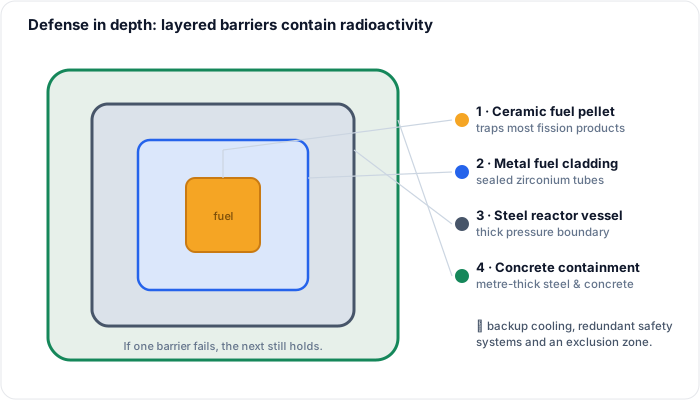
!Diagram of nuclear defence-in-depth barriers
Multiple independent barriers each contain radioactivity; if one fails, the next still holds.
Modern nuclear plants are designed using a "defence in depth" philosophy that creates multiple, independent barriers between radioactive materials and the environment. Even if one or more barriers fail, the remaining barriers continue to protect public safety [1].
The First Barrier: The Fuel Itself Uranium dioxide fuel is a ceramic material with a very high melting point (about 2,800°C) and low solubility in water. Under normal operating conditions and even during most accident scenarios, the vast majority of radioactive fission products remain trapped within the fuel pellets themselves.
The Second Barrier: Fuel Cladding Each fuel pellet is encased in a zirconium alloy tube called cladding. This metal cladding is designed to contain fission products under normal operating conditions and during most accident scenarios. The cladding is highly resistant to corrosion and maintains its integrity even at high temperatures.
The Third Barrier: The Reactor Pressure Vessel The reactor core and primary cooling system are contained within a massive steel pressure vessel with walls several inches thick. This vessel is designed to withstand extreme pressures and temperatures and is regularly inspected to ensure its continued integrity.
The Fourth Barrier: Containment Structure The most visible safety feature of nuclear plants is the containment structure—typically a reinforced concrete building with walls several feet thick. Modern containments are designed to withstand extreme events including aircraft impacts, earthquakes, tornadoes, and internal pressures from potential accidents. The containment provides the final barrier preventing any release of radioactive materials to the environment.
Beyond physical barriers, nuclear plants employ multiple active safety systems designed to prevent accidents and mitigate their consequences if they occur.
Emergency Core Cooling Systems can rapidly inject water into the reactor core if normal cooling is lost. These systems include high-pressure injection systems for small breaks in cooling lines and low-pressure systems for larger breaks. Multiple pumps and water sources ensure that cooling can be maintained even if some equipment fails.
Control Rod Systems provide the primary means of shutting down the nuclear reaction. Control rods contain materials that absorb neutrons, stopping the chain reaction when inserted into the reactor core. These systems are designed to automatically insert the rods if power is lost or emergency conditions are detected, ensuring the reactor shuts down safely.
Backup Power Systems include multiple diesel generators and battery banks to ensure that safety systems remain operational even during extended power outages. These systems are designed to operate for days or weeks without external power, providing time for additional resources to be brought to the site.
Containment Systems include not only the containment structure itself but also systems to remove heat and pressure from the containment, filter any potential releases, and maintain the containment's integrity during accident conditions.
Modern reactor designs incorporate increasingly sophisticated passive safety features that operate without electrical power or human intervention, relying instead on natural forces like gravity, convection, and the laws of physics.
Natural Circulation Cooling systems use the natural tendency of hot water to rise and cool water to sink to maintain cooling flow through the reactor core, even without pumps. This ensures that the reactor core remains cooled even if all power is lost.
Gravity-Fed Water Systems can provide emergency cooling water to the reactor core using only the force of gravity, eliminating the need for pumps or electrical power.
Passive Containment Cooling systems use natural air circulation to remove heat from the containment structure, preventing pressure buildup that could threaten containment integrity.
Inherent Safety Characteristics include physical properties of the reactor that automatically make it safer as conditions become more challenging. For example, as reactor temperature increases, the nuclear reaction naturally slows down, providing automatic protection against overheating.
Nuclear power plants operate under some of the most stringent regulatory oversight of any industry. In the United States, the Nuclear Regulatory Commission (NRC) maintains resident inspectors at every nuclear plant who monitor operations 24 hours a day, 365 days a year [3]. These inspectors have unrestricted access to all plant areas and can shut down a reactor immediately if safety concerns arise.
The regulatory framework includes:
Design Certification that requires extensive analysis and testing to demonstrate that reactor designs meet strict safety standards before any plant can be built.
Construction Oversight with inspectors monitoring every aspect of plant construction to ensure compliance with approved designs and quality standards.
Operational Monitoring through resident inspectors, periodic inspections, and comprehensive reviews of plant performance and safety systems.
Continuous Improvement requirements that mandate operators to implement safety improvements as new knowledge and technology become available.
The International Atomic Energy Agency (IAEA) provides additional oversight and coordination, sharing safety information and best practices among all countries operating nuclear power plants. This international cooperation ensures that safety improvements developed in one country quickly benefit nuclear operations worldwide.
Nuclear plant operators undergo extensive training that far exceeds that required for most other industrial operations. In the United States, reactor operators must complete approximately two years of classroom and hands-on training, pass comprehensive written and practical examinations, and receive annual retraining to maintain their licenses [3].
Training includes:
Simulator Training using full-scale replicas of actual control rooms where operators practice normal operations and emergency procedures in realistic scenarios without any risk to actual nuclear plants.
Classroom Instruction covering nuclear physics, plant systems, safety procedures, and regulatory requirements.
On-the-Job Training under the supervision of experienced operators, gradually building skills and knowledge over months or years.
Continuous Training with regular refresher courses, emergency drills, and updates on new procedures and technologies.
The nuclear industry has also invested heavily in understanding human factors—how people interact with complex systems and how to design systems and procedures to minimise the potential for human error. This includes improved control room designs, better procedures, and enhanced training methods.
The nuclear industry has continuously improved safety based on operating experience and research. Major improvements since the early days of nuclear power include:
Improved Materials with better understanding of how materials behave under radiation and thermal stress, leading to more durable and reliable components.
Advanced Instrumentation providing operators with better information about plant conditions and earlier warning of potential problems.
Enhanced Emergency Procedures based on detailed analysis of potential accident scenarios and lessons learned from actual events.
Probabilistic Risk Assessment using sophisticated mathematical models to identify potential vulnerabilities and prioritise safety improvements.
Severe Accident Management with procedures and equipment specifically designed to manage and mitigate the consequences of extremely unlikely but potentially serious accidents.
When we compare the safety of nuclear power to other forms of electricity generation, nuclear power's advantages become even more apparent:
Coal Power causes approximately 25 deaths per terawatt-hour through air pollution, mining accidents, and other hazards—500 times more than nuclear power.
Oil and Gas cause significant numbers of deaths through air pollution, explosions, fires, and other accidents associated with extraction, transportation, and combustion.
Hydroelectric Power has caused catastrophic accidents, including dam failures that have killed thousands of people in single events.
Wind and Solar have very low death rates comparable to nuclear power, but they require backup power sources that often involve fossil fuels.
Even counting Chernobyl and Fukushima, nuclear sits in the small group of sources with the lowest death rates ever measured — alongside wind and solar, and orders of magnitude below anything burned. Our World in Data, whose figures these are, notes that the differences within that bottom group are smaller than the uncertainty in the estimates; the gap to coal is not in any doubt.
New reactor designs incorporate decades of operating experience and technological advancement to achieve even higher levels of safety:
Generation III+ Reactors include enhanced safety features such as passive safety systems, improved containment designs, and greater resistance to severe accidents.
Small Modular Reactors (SMRs) use factory construction, simplified designs, and enhanced passive safety features to achieve safety levels that exceed current nuclear plants.
Advanced Reactor Concepts including high-temperature gas reactors, molten salt reactors and fast reactors rely on inherent physical properties rather than active systems. The clearest example is TRISO fuel, which retains its fission products up to about 1,600 °C — above any temperature a high-temperature gas reactor can physically reach. China demonstrated this at full scale in 2023 by cutting power to both reactors of its HTR-PM and allowing them to cool themselves with no operator action. That is a stronger claim than "impossible", because it comes with a number and a test.
These advanced designs represent the next generation of nuclear technology, building on the already excellent safety record of current nuclear plants to achieve even greater levels of safety and reliability.
Nuclear plants maintain comprehensive emergency preparedness programs that coordinate with local, state, and federal agencies to ensure public safety in the extremely unlikely event of a serious accident.
Emergency Planning Zones around nuclear plants have detailed evacuation plans, communication systems, and regular drills to ensure that protective actions can be taken quickly if needed.
Emergency Response Organisations include specially trained teams of nuclear plant personnel, local emergency responders, and federal agencies that can respond to any nuclear emergency.
Communication Systems ensure that accurate information reaches the public and emergency officials quickly, preventing panic and ensuring appropriate protective actions.
Regular Drills and Exercises test all aspects of emergency response, identifying areas for improvement and ensuring that all participants understand their roles and responsibilities.
Despite nuclear power's outstanding safety record, public perception of nuclear risks often exceeds the actual risks by orders of magnitude. This disconnect between perception and reality stems from several psychological factors:
Availability Bias causes people to overestimate risks from events that are easily remembered or widely publicized, such as nuclear accidents, while underestimating more common but less dramatic risks.
Dread Risk refers to the tendency to fear risks that seem uncontrollable, unfamiliar, or potentially catastrophic, even when the actual probability is very low.
Media Coverage of nuclear accidents is often extensive and emotional, while the routine safe operation of nuclear plants receives little attention.
Lack of Familiarity with nuclear technology leads many people to rely on fictional portrayals or outdated information rather than current scientific evidence.
Understanding these psychological factors helps explain why nuclear power faces public opposition despite its excellent safety record and highlights the importance of education and transparent communication about nuclear safety.
Nuclear safety is enhanced by extensive international cooperation that ensures safety improvements developed in one country quickly benefit nuclear operations worldwide:
International Atomic Energy Agency (IAEA) provides safety standards, conducts safety reviews, and facilitates sharing of operating experience among all countries with nuclear programs.
World Association of Nuclear Operators (WANO) enables nuclear plant operators to share safety information, conduct peer reviews, and implement best practices across the global nuclear industry.
Bilateral Agreements between countries allow for sharing of technical information, joint research programs, and coordination of safety improvements.
International Research Programs address common safety challenges and develop improved safety technologies that benefit all nuclear operators.
This international cooperation ensures that nuclear safety continues to improve globally and that lessons learned from any operating experience quickly benefit the entire nuclear industry.
Nuclear safety continues to evolve and improve through ongoing research, technological development, and operational experience:
Advanced Materials Research is developing new materials that are more resistant to radiation, corrosion, and thermal stress, improving the reliability and safety of nuclear components.
Digital Instrumentation and Control systems provide more accurate monitoring, faster response to changing conditions, and improved human-machine interfaces.
Artificial Intelligence and Machine Learning applications are being developed to predict equipment failures, optimise maintenance schedules, and enhance safety system performance.
Risk-Informed Regulation uses sophisticated risk assessment techniques to focus regulatory attention on the most safety-significant issues while reducing unnecessary regulatory burden.
The evidence is clear: nuclear power is among the safest forms of electricity generation ever developed. At about 0.03 deaths per terawatt-hour it sits in the same band as solar and wind, and several hundred times below the fossil fuels that kill through air pollution and accidents every single year.
This outstanding safety record results from multiple layers of protection, extensive regulatory oversight, comprehensive operator training, and continuous improvement based on operating experience. Modern nuclear plants incorporate decades of safety improvements and are designed to withstand extreme events while protecting public health and safety.
The few serious accidents that have occurred in nuclear power's six-decade history have led to significant safety improvements that make today's nuclear plants even safer. New reactor designs incorporate additional safety features that will make future nuclear plants safer still.
As the world seeks clean, reliable electricity to address climate change and meet growing energy demands, nuclear power offers not just environmental benefits but also proven safety performance. The choice is not between nuclear power and perfect safety—no energy source is perfectly safe. The choice is between nuclear power, with its outstanding safety record, and alternatives that cause far more deaths and environmental damage.
Nuclear power has earned its place as a safe, clean, and reliable source of electricity. The facts speak for themselves: nuclear power is not just safe—it's one of the safest technologies humanity has ever developed.
[1] Our World in Data, "What are the safest and cleanest sources of energy?" (https://ourworldindata.org/safest-sources-of-energy) for deaths per terawatt-hour; IAEA Power Reactor Information System (https://pris.iaea.org) for cumulative reactor-years. Note that Our World in Data cautions that differences between the lowest-ranked sources — nuclear, wind and solar — are smaller than the uncertainty in the estimates.
[2] United Nations Scientific Committee on the Effects of Atomic Radiation. "Evaluation of Data on Thyroid Cancer in Regions Affected by the Chernobyl Accident." UNSCEAR White Paper, 2018. https://www.unscear.org/unscear/en/publications/2017.html
[2a] United Nations Scientific Committee on the Effects of Atomic Radiation. "Levels and Effects of Radiation Exposure Due to the Accident at the Fukushima Daiichi Nuclear Power Station: UNSCEAR 2020/2021 Report, Annex B." 2021. https://www.unscear.org/unscear/en/publications/2020_2021_1.html
[3] U.S. Nuclear Regulatory Commission. "Backgrounder On Nuclear Reactor Risk." November 7, 2024. https://www.nrc.gov/reading-rm/doc-collections/fact-sheets/reactor-risk.html