The Environmental Case for Nuclear Power
Love Nuclear
Drafted with AI assistance. Every factual claim was checked against primary sources in August 2026; the sources are listed at the end of this article.
In discussions about clean energy and environmental protection, nuclear power is often overlooked or misunderstood. Yet the scientific evidence is overwhelming: nuclear energy is one of the cleanest, most environmentally friendly sources of electricity available today. This comprehensive examination reveals why nuclear power deserves recognition as a cornerstone of green energy policy and environmental stewardship.
Nuclear power is fundamentally a zero-emission clean energy source during operation [1]. Unlike fossil fuel power plants that burn coal, oil, or natural gas and release carbon dioxide and other pollutants into the atmosphere, nuclear reactors generate electricity through nuclear fission without any combustion process. The heat released by splitting uranium atoms creates steam that drives turbines, producing electricity without emitting greenhouse gases, particulate matter, or other air pollutants.
The numbers speak for themselves. According to the Nuclear Energy Institute, the United States avoided more than 471 million metric tons of carbon dioxide emissions in 2020 thanks to nuclear power [1]. To put this in perspective, this is equivalent to removing 100 million cars from the road—more than all other clean energy sources combined. This massive carbon avoidance demonstrates nuclear power's crucial role in fighting climate change.
Over the past 50 years, the use of nuclear power has reduced global CO2 emissions by over 60 gigatonnes, representing nearly two years' worth of global energy-related emissions [2]. This historical contribution to emission reductions is unmatched by any other single clean energy technology, highlighting nuclear power's proven track record in environmental protection.
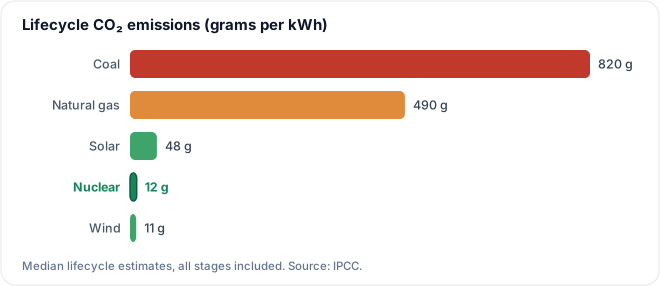
When we examine the complete lifecycle of nuclear power—including uranium mining, fuel processing, plant construction, operation, and eventual decommissioning—nuclear energy still maintains one of the lowest carbon footprints of any electricity generation technology. Lifecycle analyses consistently show that nuclear power produces between 10-15 grams of CO2 equivalent per kilowatt-hour, comparable to wind power and significantly lower than solar photovoltaics [2].
Beyond climate benefits, nuclear power provides immediate and tangible improvements to air quality that directly save lives. Fossil fuel combustion releases not only carbon dioxide but also sulfur dioxide, nitrogen oxides, particulate matter, and other pollutants that cause respiratory diseases, heart conditions, and premature death.
By avoiding soot, sulfur dioxide, and nitrogen oxides, nuclear plants help prevent asthma attacks, respiratory diseases, heart conditions, and other health problems associated with air pollution [3]. The World Health Organization and Institute for Health Metrics and Evaluation report that between 4.2 million and 4.5 million people die prematurely from exposure to outdoor air pollution annually worldwide [4]. In the United States alone, approximately 194,000 annual premature deaths result from fossil fuel air pollution, representing the loss of 5.7 million life years [4].
Recent economic research has quantified nuclear power's life-saving potential. A National Bureau of Economic Research study found that each additional nuclear power plant built could save more than 800,000 life years by reducing air pollution [4]. The study examined the aftermath of the Chernobyl accident, which led to the cancellation of nearly 400 nuclear plants worldwide. The researchers calculated that this reduction in nuclear capacity resulted in increased fossil fuel use and air pollution that killed far more people than the Chernobyl accident itself—by several orders of magnitude.
Climate scientist James Hansen and researcher Pushker Kharecha found that 1.84 million lives were saved by nuclear power displacing coal over the last half century [5]. This remarkable figure demonstrates that nuclear power is not just environmentally beneficial in theory—it has already prevented nearly two million deaths through improved air quality.
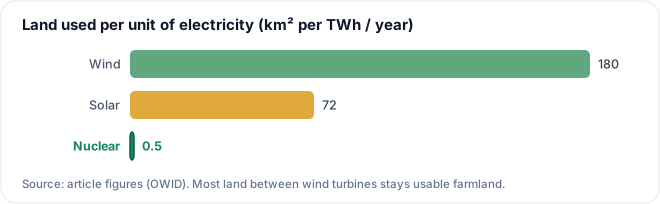
!Bar chart comparing land use per unit of electricity
Nuclear's energy density means a tiny land footprint per unit of electricity.
One of nuclear power's most impressive environmental advantages is its incredibly small land footprint relative to the amount of electricity generated. Nuclear energy produces more electricity on less land than any other clean-air source [1].
A typical 1,000-megawatt nuclear facility needs little more than one square mile to operate [1]. In contrast, wind farms require substantially more total land area to produce the same amount of electricity, though most of the land between wind turbines remains usable for agriculture. Solar plants also require significantly more space. To put scale in concrete terms, producing the same amount of electricity as a typical commercial nuclear reactor would require more than 3 million solar panels or more than 430 wind turbines.
This land efficiency has profound environmental implications. By concentrating enormous amounts of clean electricity generation in a small area, nuclear power leaves more land available for agriculture, forests, wildlife habitat, and other uses. This is particularly important as the world's population grows and competition for land intensifies.
The small footprint also means nuclear plants can often be located close to existing transmission infrastructure or even at the sites of retired fossil fuel plants, minimising the need for new transmission lines that would otherwise fragment habitats and require additional land clearing.
Nuclear fuel represents perhaps the most remarkable example of resource efficiency in all of human technology. The energy density of nuclear fuel is approximately one million times greater than that of traditional energy sources [1]. A single uranium fuel pellet the size of a fingertip contains as much energy as a ton of coal.
This extraordinary energy density translates into minimal resource extraction and waste production. All of the used nuclear fuel produced by the U.S. nuclear energy industry over the last 60 years could fit on a football field at a depth of less than 10 yards [1]. Compare this to the billions of tons of coal ash, the millions of tons of carbon dioxide, and the vast quantities of other waste products generated by fossil fuel plants over the same period.
The mining footprint for nuclear fuel is correspondingly small. Nuclear power requires no battery materials such as lithium, manganese, nickel, or cobalt, nor rare earth elements like europium, terbium, or neodymium that are needed for solar panels and wind turbines [6]. Nuclear plants use modest amounts of copper, steel, and concrete—materials that are abundant and recyclable.
Uranium mining itself has evolved to become increasingly environmentally responsible. Modern in-situ leaching techniques can extract uranium with minimal surface disturbance, and strict regulations govern the restoration of mining sites. The small quantities of uranium needed mean that even with growing nuclear capacity, uranium mining will remain a minor industrial activity compared to coal mining or oil extraction.
While nuclear plants do use water for cooling, modern designs are increasingly efficient in their water usage and can be designed to minimise environmental impact on aquatic ecosystems. Many nuclear plants use closed-loop cooling systems that dramatically reduce water consumption compared to once-through cooling systems.
Advanced reactor designs under development promise even greater water efficiency, with some air-cooled designs requiring no water for cooling at all. These innovations will further reduce nuclear power's environmental footprint while maintaining its other advantages.
The thermal efficiency of nuclear plants—typically around 33-35%—is comparable to coal plants and better than many other thermal power sources. Combined heat and power applications, where waste heat is used for district heating or industrial processes, can achieve overall efficiencies of 80% or higher, further improving nuclear power's environmental performance.
Nuclear waste, while requiring careful management, represents a remarkably small environmental challenge compared to the waste streams from other energy sources. The total volume of high-level nuclear waste is tiny, and unlike chemical pollutants that remain toxic forever, radioactive materials naturally decay over time, eventually becoming harmless.
Deep geological disposal, the internationally preferred method for managing high-level nuclear waste, isolates these materials in stable rock formations hundreds of meters underground [7]. Multiple engineered and natural barriers ensure that radioactive materials remain contained for the thousands of years needed for them to decay to safe levels.
Finland's Onkalo repository shows how close this is to reality. In August 2026 the Finnish regulator completed the world's first full safety assessment of a geological repository and found no obstacle to licensing it; the government's decision is expected in autumn 2026, with disposal to begin shortly after [7]. Sweden approved its repository at Forsmark in 2022 and is building. Canada chose its site in 2024. The United States has not — Yucca Mountain has been unfunded since 2010 — so American used fuel remains in dry storage at the plants that produced it. No repository is yet accepting fuel anywhere, which is worth saying plainly: the first one is months away, not decades.
Importantly, nuclear waste can also be recycled. Used nuclear fuel still contains about 95% of its original uranium, plus valuable plutonium created during reactor operation. Countries like France routinely reprocess used fuel, recovering these materials for reuse and dramatically reducing the volume of waste requiring disposal.
!Bar chart of lifecycle CO2 emissions by electricity source
Over its whole life cycle, nuclear is among the lowest-carbon sources — on par with wind.
When we compare the environmental impacts of different electricity generation technologies across their complete lifecycles, nuclear power consistently ranks among the cleanest options available:
Carbon Emissions: Nuclear power produces 10-15 grams of CO2 equivalent per kilowatt-hour, comparable to wind (10-15 g) and hydroelectric (10-25 g), and lower than solar photovoltaics (20-50 g, with modern panels often at the lower end of this range), natural gas (350-490 g), or coal (820-1,050 g) [2].
Land Use: Nuclear requires about 0.5 square kilometres per TWh of annual electricity generation, compared to 72 km² for solar and 180 km² for wind [8].
Material Requirements: Nuclear plants require minimal materials per unit of electricity generated over their 60-80 year operating lives, with no ongoing fuel extraction comparable to fossil fuels.
Waste Production: Nuclear waste is contained, managed, and decreases in toxicity over time, unlike chemical pollutants from fossil fuels that persist indefinitely in the environment.
The environmental benefits of nuclear power are increasingly recognised by international organisations and environmental scientists. The Intergovernmental Panel on Climate Change (IPCC) includes nuclear power as a key technology for limiting global warming to 1.5°C [9]. The International Energy Agency projects that nuclear power must double by 2050 to achieve net-zero emissions [10].
Even traditionally anti-nuclear environmental organisations are beginning to acknowledge nuclear power's environmental advantages. Some prominent environmentalists, including James Hansen, Kerry Emanuel, and Tom Wigley, have publicly endorsed nuclear power as essential for addressing climate change.
Despite overwhelming scientific evidence of nuclear power's environmental benefits, some environmental groups continue to oppose nuclear energy. This opposition often stems from outdated information, fear-based messaging from the 1970s and 1980s, or philosophical objections rather than scientific analysis.
The irony is that opposition to nuclear power tends to keep fossil fuels running longer than they needed to. Germany is the case study, and it needs stating accurately rather than as a slogan. German power-sector emissions did rise in 2021-22, when the last reactors closed and gas was scarce, but they have since fallen sharply: coal generation in 2024 was the lowest in about seventy years and total emissions the lowest since the 1950s [11]. Anyone claiming German emissions are still climbing is three years out of date.
The real criticism is the counterfactual. Germany closed roughly 20 GW of working, already-paid-for, zero-carbon generation and spent two decades building renewables to replace it. Had that build-out replaced coal instead, Germany would be at something close to French carbon intensity today. France has run its grid on nuclear for forty years — around 68% today, down from a peak above 75%, with a dip to 63% in 2022 during a corrosion-inspection programme — and French electricity has remained several times cleaner per kilowatt-hour than German electricity throughout [11]. The lesson is not that renewables failed. It is that closing clean plants to build clean plants buys nothing.
This "green paradox" demonstrates the importance of evidence-based environmental policy. Well-intentioned opposition to nuclear power can inadvertently harm the environment by prolonging dependence on fossil fuels and increasing greenhouse gas emissions.
Nuclear power's small land footprint provides significant benefits for biodiversity conservation. By generating large amounts of electricity on minimal land area, nuclear power leaves more space for natural habitats and wildlife corridors.
Some nuclear plant sites have even become inadvertent nature reserves. The exclusion zones around nuclear facilities often support thriving wildlife populations, demonstrating that properly managed nuclear technology can coexist with healthy ecosystems. Studies of the Chernobyl exclusion zone, despite the accident, show abundant wildlife populations that have recovered in the absence of human activity.
Modern nuclear plants are designed with environmental protection in mind, incorporating fish protection systems, wildlife corridors, and habitat restoration programs. Many nuclear operators actively manage their sites for biodiversity, creating wetlands, grasslands, and forests that support native species.
As the world grapples with climate change, air pollution, and growing energy demands, nuclear power offers a proven path toward environmental sustainability. The technology exists today to dramatically expand clean nuclear energy while maintaining the highest safety and environmental standards.
Advanced reactor designs promise even greater environmental benefits, with smaller footprints, enhanced safety features, and the ability to consume existing nuclear waste as fuel. Small Modular Reactors could bring clean nuclear energy to smaller communities and industrial applications, further reducing reliance on fossil fuels.
The environmental case for nuclear power is not just compelling—it's overwhelming. Nuclear energy prevents millions of tons of carbon dioxide emissions, saves thousands of lives through improved air quality, requires minimal land and resources, and produces manageable amounts of waste that decrease in toxicity over time.
The scientific evidence is clear: nuclear power is one of the cleanest, greenest forms of electricity generation available today. From preventing climate change to saving lives through cleaner air, from protecting land for wildlife to minimising resource extraction, nuclear energy delivers environmental benefits that are both immediate and long-lasting.
As we work to build a sustainable energy future, we cannot afford to ignore nuclear power's proven environmental advantages. The choice is not between nuclear and renewables—it's between clean energy sources like nuclear, wind, and solar versus continued dependence on fossil fuels that pollute our air, warm our planet, and threaten our health.
Nuclear power has already prevented nearly two million deaths and billions of tons of carbon emissions. With continued technological advancement and growing recognition of its environmental benefits, nuclear energy can play an even larger role in protecting our planet for future generations.
The time has come to embrace nuclear power not despite environmental concerns, but because of them. Nuclear energy isn't just clean and green—it's essential for environmental protection and climate action.
[1] U.S. Department of Energy. "3 Reasons Why Nuclear is Clean and Sustainable." March 31, 2021. https://www.energy.gov/ne/articles/3-reasons-why-nuclear-clean-and-sustainable
[2] International Energy Agency. "Nuclear Power in a Clean Energy System." May 28, 2019. https://www.iea.org/reports/nuclear-power-in-a-clean-energy-system
[3] Kharecha, Pushker A., and James E. Hansen. "Prevented Mortality and Greenhouse Gas Emissions from Historical and Projected Nuclear Power." Environmental Science & Technology 47, no. 9 (2013): 4889-4895. https://pubs.acs.org/doi/10.1021/es3051197
[4] World Health Organization. "Ambient (outdoor) air pollution." Fact sheet, 2024. https://www.who.int/news-room/fact-sheets/detail/ambient-(outdoor)-air-quality-and-health
[5] Kharecha, Pushker A., and James E. Hansen. "Prevented Mortality and Greenhouse Gas Emissions from Historical and Projected Nuclear Power." Environmental Science & Technology 47, no. 9 (2013): 4889-4895. https://pubs.acs.org/doi/10.1021/es3051197
[6] Finkel, Alan. "Here's why there is no nuclear option for Australia to reach net zero." The Guardian. March 22, 2024. https://www.theguardian.com/commentisfree/2024/mar/22/heres-why-there-is-no-nuclear-option-for-australia-to-reach-net-zero
[7] World Nuclear Association. "Storage and Disposal of Radioactive Waste." April 30, 2024. https://world-nuclear.org/information-library/nuclear-fuel-cycle/nuclear-waste/storage-and-disposal-of-radioactive-waste
[8] Our World in Data. "Nuclear Energy." 2020. https://ourworldindata.org/nuclear-energy
[9] IPCC. "Global Warming of 1.5°C." 2018.
[10] International Energy Agency. "Nuclear Power and Secure Energy Transitions." 2022. https://www.iea.org/reports/nuclear-power-and-secure-energy-transitions/executive-summary
[11] Ember. "European Electricity Review" and country carbon-intensity data. https://ember-energy.org/data/ See also Agora Energiewende, "Die Energiewende in Deutschland: Stand der Dinge 2024" (January 2025), for German power-sector emissions and coal generation.