Love Nuclear
Drafted with AI assistance. Every factual claim was checked against primary sources in August 2026; the sources are listed at the end of this article.
Small Modular Reactors (SMRs) represent the most exciting development in nuclear technology since the dawn of the atomic age. These innovative reactors promise to revolutionize nuclear power by making it more flexible, affordable, and accessible while maintaining the safety and environmental benefits that make nuclear energy indispensable for addressing climate change. SMRs are not just smaller versions of traditional nuclear plants—they represent a fundamental reimagining of nuclear technology that could transform the global energy landscape.
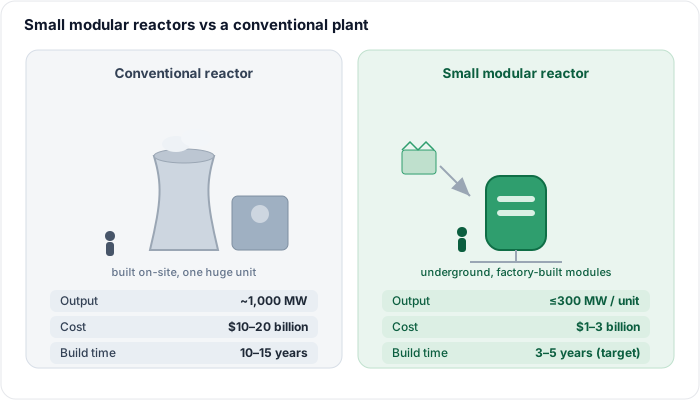
!Comparison of a small modular reactor and a conventional plant
SMRs are smaller, factory-built, and cheaper per unit than conventional plants.
Small Modular Reactors are advanced nuclear reactors that have a power capacity of up to 300 MW(e) per unit, which is about one-third of the generating capacity of traditional nuclear power reactors [1]. However, the "small" in SMR refers to more than just physical size—it represents a completely different approach to nuclear power plant design, construction, and deployment.
Size Advantages: The smaller size of SMRs offers numerous benefits compared to large traditional reactors. SMRs can be sited on locations not suitable for larger nuclear power plants, including smaller electrical grids, remote locations, and areas with limited water resources. The reduced size also means lower absolute capital costs, making nuclear power accessible to utilities and countries that cannot afford large nuclear plants.
Modular Design: The modular aspect of SMRs refers to their factory-fabricated, truck-transportable reactor modules that can be assembled into larger power plants. This modularity enables economies of series production rather than the economies of scale that traditional large reactors depend upon. Multiple modules can be deployed incrementally to match growing energy demand, providing unprecedented flexibility in nuclear power deployment.
Advanced Technology Integration: SMRs incorporate decades of nuclear operating experience and the latest technological advances. Most SMR designs feature enhanced safety systems, simplified operations, and improved economics compared to traditional nuclear plants. Many SMRs use passive safety systems that rely on natural forces like gravity and convection rather than active systems requiring electrical power.
SMRs represent a fundamental shift in nuclear reactor design philosophy, incorporating innovations that address many of the challenges associated with traditional large nuclear plants:
Passive Safety Systems: Most SMR designs rely heavily on passive safety systems that operate without electrical power or human intervention. These systems use natural forces such as gravity, natural circulation, and convection to maintain safety functions. If power is lost or systems fail, the reactor automatically shuts down and remains in a safe condition without any operator action.
Integral Design: Many SMRs use integral reactor designs where the steam generator, pressurizer, and other major components are located inside the reactor vessel. This eliminates large-diameter piping that could potentially break and cause accidents, significantly improving safety and simplifying the plant design.
Underground Deployment: Several SMR designs are intended to be deployed underground, providing additional protection against external threats including extreme weather, aircraft impacts, and security concerns. Underground deployment also reduces the visual impact of nuclear facilities.
Enhanced Security: The smaller size and often underground deployment of SMRs make them inherently more secure than large nuclear plants. Many SMR designs can operate for years without refueling, reducing the frequency of fuel transportation and handling.
Simplified Operations: SMRs are designed for simpler operation with smaller operating crews and reduced maintenance requirements. Some designs can operate autonomously for extended periods, making them suitable for remote locations or applications where skilled operators may not be readily available.
One of the most significant advantages of SMRs is their potential to make nuclear power more economically attractive through several innovative approaches:
Lower Capital Costs: SMRs cost more per kilowatt than large reactors — they lose the economies of scale that made reactors big in the first place. The argument is that they gain more back through factory production and repetition than they lose in scale, and that a smaller cheque is easier to write.
The honest state of the evidence is that this is a projection, not yet a result. Vendor estimates of $1-3 billion per unit are for nth-of-a-kind plants on a mature production line. The first-of-a-kind Western projects now being costed in detail come in nearer $4-6 billion — the cancelled NuScale project in Utah had reached about $9,300 per kilowatt before it was abandoned in 2023 — against $10-30 billion for a large twin-unit station. The smaller cheque is real. The lower cost per kilowatt is a bet on repetition that nobody has yet won or lost.
Factory Construction: SMRs are designed to be manufactured in factories rather than constructed on-site like traditional nuclear plants. Factory construction offers several advantages including better quality control, reduced construction time, economies of series production, and protection from weather delays. Factory-built modules can be transported to sites and assembled, dramatically reducing on-site construction time and costs.
Incremental Deployment: SMRs can be deployed incrementally, with additional modules added as demand grows. This allows utilities to match capacity additions with demand growth and spread capital costs over time. It also reduces the financial risk associated with large nuclear projects that must be completed before generating any revenue.
Reduced Financing Costs: The lower capital costs and shorter construction times of SMRs reduce financing costs, which represent a significant portion of nuclear power costs. SMRs also reduce the risk of cost overruns and schedule delays that have plagued some large nuclear projects.
Operational Savings: SMRs are designed for reduced operating and maintenance costs through simplified designs, longer refueling intervals, and smaller operating crews. Some SMR designs can operate for 3-7 years between refuelings, compared to 12-24 months for traditional reactors.
SMRs incorporate advanced safety features that represent significant improvements over traditional nuclear reactor designs:
Inherent Safety: Many SMR designs incorporate inherent safety features based on the laws of physics rather than engineered systems. For example, as reactor temperature increases, the nuclear reaction naturally slows down, providing automatic protection against overheating. These inherent safety features cannot fail because they are based on fundamental physical properties.
Passive Safety Systems: SMR safety systems rely on natural forces rather than active components that require electrical power. Passive systems include:
Walk-Away Safe: Many SMR designs are "walk-away safe," meaning that if all systems fail and all operators leave, the reactor will automatically shut down and remain in a safe condition indefinitely without any human intervention or external power.
Reduced Accident Consequences: The smaller size and enhanced safety features of SMRs mean that even in the extremely unlikely event of an accident, the consequences would be much smaller than those possible with large reactors. Many SMR designs eliminate the possibility of large radioactive releases entirely.
Enhanced Security: SMRs offer improved security through smaller size, underground deployment options, and reduced need for fuel handling. Some designs can operate for decades without refueling, eliminating the security risks associated with frequent fuel transportation.
SMRs offer unprecedented versatility in applications, extending nuclear power beyond traditional electricity generation:
Remote Power Generation: SMRs can provide reliable electricity to remote communities, mining operations, and military bases that are not connected to large electrical grids. Their small size and autonomous operation make them ideal for locations where other power sources are impractical or expensive.
Industrial Process Heat: Many SMR designs can provide high-temperature heat for industrial processes including steel production, cement manufacturing, chemical processing, and hydrogen production. This capability could enable nuclear power to decarbonize industrial sectors that are difficult to electrify.
Desalination: SMRs can provide both electricity and heat for seawater desalination, addressing water scarcity while providing clean energy. The combination of nuclear power and desalination could provide both energy and water security for coastal regions.
District Heating: SMRs can provide waste heat for district heating systems, dramatically improving overall energy efficiency. Combined heat and power applications can achieve overall efficiencies of 80% or higher.
Hydrogen Production: SMRs can provide the steady, high-temperature heat needed for efficient hydrogen production through high-temperature electrolysis or thermochemical processes. Nuclear-produced hydrogen could serve as a clean fuel for transportation, industrial processes, and energy storage.
Grid Stabilization: SMRs can provide grid stability services for electrical systems with high penetrations of variable renewable energy. Their ability to rapidly adjust output and provide grid services makes them ideal partners for wind and solar power.
SMR development is a global phenomenon, with dozens of designs under development in multiple countries:
United States: The U.S. leads in SMR development with multiple designs under regulatory review. NuScale Power received the NRC's Standard Design Approval in 2020 - the first SMR to reach that milestone - followed by the full Design Certification Rule in January 2023. However, NuScale's first planned commercial project (the Carbon Free Power Project in Idaho) was cancelled in late 2023 due to rising costs and insufficient customer commitments, highlighting the economic challenges that remain for first-of-a-kind SMR deployments. Several other designs continue to progress through the regulatory approval process. The U.S. Department of Energy is supporting SMR development through research funding and demonstration projects.
Canada: Canada is actively supporting SMR development through its SMR Action Plan and has committed to deploying SMRs by 2030. Several provinces are planning SMR projects, and Canadian companies are developing innovative SMR technologies.
United Kingdom: The UK government is investing heavily in SMR development as part of its net-zero strategy. Rolls-Royce SMR is developing a 470 MW pressurised water reactor design with government support and has entered the Generic Design Assessment process with the UK nuclear regulators. First deployment timelines have been revised and are now targeted for the mid-2030s rather than 2030.
Russia: Russia has deployed the world's first floating nuclear power plant using SMR technology and is developing additional SMR designs for both domestic and export markets.
China: China is developing multiple SMR designs and has begun construction of demonstration reactors. Chinese SMR development focuses on both electricity generation and industrial applications.
Other Countries: Argentina, South Korea, Japan, and several European countries have active SMR development programs, demonstrating the global interest in this technology.
Several SMR designs are leading the way in demonstrating the potential of this technology:
NuScale Power Module: NuScale's design is a 77 MW integral pressurized water reactor that can be deployed in modules of up to 12 units. The design features passive safety systems, underground deployment, and a simplified control room. NuScale received the NRC's Standard Design Approval in 2020 and the full Design Certification Rule in January 2023, making it the first SMR to complete NRC design certification. NuScale's first planned commercial project was cancelled in 2023 due to cost challenges, underscoring the economic hurdles still facing first-of-a-kind SMR projects.
Rolls-Royce SMR: The UK-based design is a 470 MW(e) pressurised water reactor designed for factory construction and modular assembly. At 470 MW(e), this design exceeds the IAEA's formal SMR threshold of 300 MW(e) per unit and is sometimes referred to as an Advanced Modular Reactor (AMR); however, it shares the modular construction and standardisation principles that characterise the SMR category. The design emphasises standardisation, factory construction, and reduced construction time. The project is progressing through the UK Generic Design Assessment regulatory process, with first deployment now targeted for the mid-2030s.
TerraPower Natrium: This design combines a 345 MW sodium-cooled fast reactor with molten salt energy storage, providing both baseload power and the ability to rapidly adjust output to complement renewable energy sources.
X-energy Xe-100: A high-temperature gas-cooled reactor using TRISO fuel, producing electricity and industrial process heat. Its safety case rests on a specific, testable number rather than an absolute: TRISO particles retain their fission products up to about 1,600 °C, and the reactor's physics and geometry mean it cannot reach that temperature even with all cooling lost and no operator action. China demonstrated exactly this in 2023, deliberately cutting power to both reactors of its full-scale HTR-PM and letting them cool themselves to a safe state with no intervention. "Cannot melt down under any circumstances" is the sort of claim that only has to fail once; "holds to 1,600 °C, which is above anything it can reach, and here is the full-scale demonstration" is stronger because it can be checked.
Westinghouse eVinci: A 5 MW heat pipe reactor designed for remote applications, the eVinci can operate for 8+ years without refueling and requires minimal maintenance.
The factory construction approach represents one of the most significant innovations in SMR development:
Quality Control: Factory construction provides superior quality control compared to field construction. Manufacturing in controlled environments with standardized processes reduces the potential for construction errors and improves overall quality.
Speed: Factory construction can proceed in parallel with site preparation, dramatically reducing overall project schedules. SMR projects could be completed in 3-5 years compared to 10-15 years for traditional nuclear plants.
Cost Reduction: Series production in factories enables learning curve effects and economies of scale that can reduce costs over time. As more SMRs are built, costs are expected to decrease significantly.
Standardization: Factory construction enables standardization of designs, components, and processes, further reducing costs and improving reliability.
Supply Chain Development: SMR manufacturing will create new supply chains and manufacturing capabilities that can support multiple reactor deployments.
SMRs offer significant environmental benefits that make them essential for climate action:
Zero Operational Emissions: Like all nuclear power, SMRs produce no greenhouse gas emissions during operation, providing clean electricity that can replace fossil fuel generation.
Small Land Footprint: SMRs require minimal land area compared to other clean energy sources. A typical SMR facility might occupy less than 50 acres compared to thousands of acres for equivalent solar or wind capacity.
Minimal Resource Requirements: SMRs require very small amounts of fuel and produce minimal waste compared to other energy sources. The high energy density of nuclear fuel means minimal mining and transportation impacts.
Long Operating Life: SMRs are designed to operate for 60+ years, providing decades of clean electricity from a single facility.
Waste Heat Utilisation: SMRs can utilise waste heat for beneficial purposes including district heating, desalination, and industrial processes, improving overall energy efficiency.
While SMRs offer significant advantages, several challenges must be addressed for successful deployment:
Regulatory Approval: SMRs require approval from nuclear regulatory agencies, which can be a lengthy and expensive process. However, regulators are developing new approaches specifically for SMRs that could streamline approval processes.
First-of-a-Kind Costs: The first SMRs will likely be more expensive than projected costs for series production. Early projects must demonstrate the technology and establish manufacturing capabilities.
Public Acceptance: SMRs must gain public acceptance, which requires education about their safety features and benefits. The smaller size and enhanced safety of SMRs may help with public acceptance.
Financing: SMR projects require financing mechanisms appropriate for their smaller size and different risk profile compared to large nuclear plants.
Skilled Workforce: SMR deployment requires a skilled workforce for manufacturing, construction, and operation, necessitating education and training programs.
SMR development benefits from international cooperation that can accelerate deployment and reduce costs:
Technology Sharing: Countries are cooperating on SMR research and development, sharing costs and expertise to accelerate technology development.
Regulatory Harmonization: International efforts are underway to harmonize SMR regulatory approaches, reducing the cost and time required for multi-country deployments.
Export Opportunities: SMR technology represents a significant export opportunity for countries that develop successful designs, creating economic benefits and supporting global clean energy deployment.
Development Assistance: SMRs could provide clean energy for developing countries through international cooperation and financing mechanisms.
Market projections suggest that SMRs could capture a significant share of the global nuclear market:
Market Size: Various studies project that the global SMR market could reach $100-300 billion by 2040, representing hundreds of reactor deployments worldwide.
Deployment Timeline: The first commercial SMRs are expected to begin operation in the mid-2020s, with widespread deployment possible by 2030.
Cost Reductions: Series production is expected to reduce SMR costs significantly, potentially making them cost-competitive with other clean energy sources.
Global Impact: Widespread SMR deployment could provide thousands of megawatts of clean electricity, significantly contributing to global decarbonization efforts.
Beyond current SMR designs, advanced concepts promise even greater capabilities:
Micro-Reactors: Very small reactors (1-20 MW) designed for specific applications including remote power, emergency response, and space exploration.
Molten Salt Reactors: SMRs using liquid fuel that can consume existing nuclear waste and provide enhanced safety through inherent characteristics.
High-Temperature Reactors: SMRs that can provide very high-temperature heat for industrial processes and hydrogen production.
Floating SMRs: Reactor designs deployed on ships or floating platforms for coastal power generation and desalination.
Space SMRs: Reactor designs for space exploration and lunar/Mars power systems.
SMR development and deployment will create significant economic opportunities:
Manufacturing Jobs: SMR manufacturing will create thousands of high-skilled manufacturing jobs in factory facilities.
Construction Jobs: SMR deployment will create construction jobs for site preparation and module assembly.
Operating Jobs: SMR operation will create long-term, high-paying jobs in local communities.
Supply Chain Development: SMR manufacturing will develop new supply chains and support industries.
Export Opportunities: Successful SMR programs can create export opportunities worth billions of dollars.
SMRs are particularly well-suited to complement renewable energy sources:
Load Following: Many SMR designs can adjust their output to complement variable renewable generation, providing grid stability services.
Hybrid Systems: SMRs can be integrated with renewable energy and storage systems to provide comprehensive clean energy solutions.
Grid Services: SMRs can provide grid stability services that become increasingly valuable as renewable penetration increases.
Industrial Integration: SMRs can provide steady industrial heat while renewables provide variable electricity, enabling comprehensive industrial decarbonization.
Small Modular Reactors represent a revolutionary advancement in nuclear technology that could transform the global energy landscape. By combining the proven benefits of nuclear power—reliability, cleanliness, and safety—with innovative designs that address traditional nuclear power challenges, SMRs offer a pathway to widespread nuclear deployment that was previously impossible.
The factory construction approach, enhanced safety features, and versatile applications of SMRs make nuclear power accessible to new markets and applications. From providing electricity to remote communities to enabling industrial decarbonization, SMRs offer solutions to energy challenges that no other technology can address as effectively.
As the world struggles to address climate change while meeting growing energy demands, SMRs provide a proven, scalable solution that can complement renewable energy sources while providing the reliability and consistency that modern society requires. The global development of SMR technology demonstrates international recognition of their potential to contribute to clean energy goals.
The innovations embodied in SMRs—passive safety, modular construction, factory manufacturing, and versatile applications—represent decades of nuclear engineering advancement focused on making nuclear power safer, more affordable, and more accessible. These innovations position SMRs as essential technologies for achieving deep decarbonization while maintaining energy security and economic development.
SMRs are not just the future of nuclear power—they are the future of clean energy. Their ability to provide reliable, clean electricity in a variety of applications makes them indispensable for addressing the climate challenge while supporting economic growth and development. The SMR revolution is just beginning, and its impact on global energy systems will be transformational.
[1] International Atomic Energy Agency. "What are Small Modular Reactors (SMRs)?" September 13, 2023. https://www.iaea.org/newscenter/news/what-are-small-modular-reactors-smrs
[2] U.S. Department of Energy. "Advanced Small Modular Reactors (SMRs)." 2023. https://www.energy.gov/ne/advanced-small-modular-reactors-smrs
[3] World Nuclear Association. "Small Nuclear Power Reactors." January 2024. https://world-nuclear.org/information-library/nuclear-fuel-cycle/nuclear-power-reactors/small-nuclear-power-reactors