Personal Journeys of Discovery and Advocacy
Love Nuclear
Drafted with AI assistance. Every factual claim was checked against primary sources in August 2026; the sources are listed at the end of this article.
Behind the statistics, technical specifications, and policy debates surrounding nuclear power are real people whose lives have been shaped by their experiences with nuclear technology. These personal stories—from nuclear workers who discovered the truth about their industry, to environmental activists who changed their minds, to communities that have thrived alongside nuclear facilities—provide powerful testimony to nuclear power's positive impact on individuals and society. These authentic voices offer insights that no amount of technical data can provide, revealing the human dimension of nuclear energy and its role in building a better future.
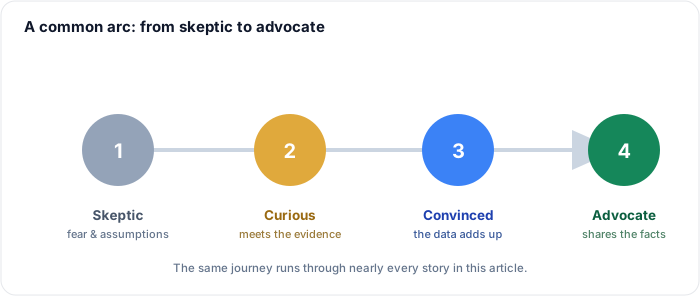
!Diagram of the journey from sceptic to nuclear advocate
The same arc — sceptic to advocate — runs through nearly every story here.
Some of the most compelling nuclear advocates are those who began as sceptics or opponents, only to change their minds when confronted with evidence that contradicted their preconceptions.
Heather Hoff's journey from nuclear sceptic to passionate advocate illustrates how direct experience with nuclear technology can transform perspectives. In 2004, Hoff was working at a clothing store in San Luis Obispo, California, with a degree in materials engineering but struggling to find meaningful work. Despite her engineering background, she shared the common suspicion of nuclear power that characterized many environmentally conscious Americans.
Her mother had been pregnant with her during the Three Mile Island accident in 1979, and Hoff grew up in an unconventional family that lived in a trailer with a composting toilet. She considered herself an environmentalist and took it for granted that environmentalism and nuclear power were incompatible [1].
When Hoff decided to apply for a job at the nearby Diablo Canyon Power Plant, it was primarily for economic reasons—the plant offered stable, well-paying employment in a region with limited opportunities. She was hired as a plant operator, a position that took her on daily rounds of the facility, checking equipment performance and hunting for signs of malfunction.
Still sceptical about nuclear safety, Hoff asked constant questions about the technology. "When four-thirty on Friday came, my co-workers were, like, 'Shut up, Heather, we want to go home,'" she recalled. "When I finally asked enough questions to understand the details, it wasn't that scary" [1].
Over the years, Hoff grew increasingly comfortable at the plant and began to understand the reality of nuclear technology. She learned that Diablo Canyon, which accounts for roughly nine percent of California's electricity, occupies fewer than 600 acres and can generate energy at all hours regardless of weather conditions. Most importantly, she discovered that nuclear power generation produces no carbon dioxide or air pollutants.
This realization was transformative. Hoff began to believe that fears of nuclear energy were not just misguided but dangerous, preventing society from using a technology that could address climate change while providing clean, reliable electricity. Her job no longer seemed to be in tension with her environmental values—instead, it felt like an expression of her deepest convictions.
When Diablo Canyon faced closure due to political pressure rather than safety concerns, Hoff became an activist. She worked with environmental advocate Michael Shellenberger to organise plant employees and their families, writing letters to officials and educating the public about nuclear power's benefits. Eventually, she co-founded Mothers for Nuclear, an organisation that advocates for nuclear power as essential for environmental protection.
Kristin Zaitz's story parallels Hoff's journey from scepticism to advocacy. A civil engineer who began working at Diablo Canyon in 2001, Zaitz came from an environmentally minded family and left-leaning social circle that predisposed her to distrust nuclear power. When she first contemplated working at the plant, she imagined the rat-infested Springfield Nuclear Power Plant from "The Simpsons," where green liquid oozes out of tanks.
Zaitz's work involved conducting structural analyses, including earthquake fortification studies, and managing projects that gave her intimate knowledge of the plant's safety systems. Like Hoff, she gradually realised that her work actually aligned with her environmental values. "That was shocking to me," she told reporters [1].
The transformation from sceptic to advocate was not immediate but occurred through daily exposure to the reality of nuclear technology. Zaitz learned about the multiple safety systems, the rigorous regulatory oversight, and the environmental benefits of nuclear power. She discovered that the fictional portrayals and popular fears about nuclear power bore little resemblance to the actual technology.
When Diablo Canyon faced closure, Zaitz joined Hoff in founding Mothers for Nuclear. They chose this name deliberately, capitalizing on their status as mothers to challenge the perception that caring parents should oppose nuclear power. "We wanted to be really clear that we think nuclear needs to be part of the solution," Zaitz explained [1].
Long-term nuclear industry employees provide unique perspectives on nuclear power's evolution and safety record.
Workers who experienced the Three Mile Island accident in 1979 offer valuable insights into nuclear safety and the industry's response to challenges. While the accident was serious, it demonstrated the effectiveness of nuclear safety systems and led to significant improvements in reactor design and operation.
Many TMI veterans describe how the accident, while frightening at the time, ultimately strengthened their confidence in nuclear safety. The containment structure performed as designed, holding back the great majority of the radioactive material. Some radioactive gas was vented and released, but the average dose to people living nearby was about 1 millirem — roughly a sixth of a chest X-ray — and decades of epidemiological follow-up have found no detectable health effects — despite a partial core meltdown. The accident led to enhanced training programs, improved procedures, and better instrumentation that made nuclear plants even safer.
These workers often emphasize how the nuclear industry's response to TMI—comprehensive analysis, systematic improvements, and enhanced safety culture—demonstrates the industry's commitment to continuous improvement. Unlike other industries that might minimise problems or resist change, the nuclear industry embraced the lessons from TMI and used them to enhance safety across the entire fleet.
The workers who responded to the Fukushima Daiichi accident in 2011 provide powerful testimony to the dedication and professionalism of nuclear workers. Despite facing unprecedented challenges from the massive earthquake and tsunami, plant workers and emergency responders worked tirelessly to minimise the consequences of the accident.
The "Fukushima 50" — the on-shift crews and the contractors who came in behind them — became symbols of the response, working in rotation through high-dose areas to keep cooling water moving. Separately, more than 500 retired Japanese engineers and technicians formed a Skilled Veterans Corps and volunteered to take the younger workers' places, reasoning that radiation risk mattered less at their age. The government never took up the offer, but it says something about how nuclear workers understand their obligations.
Many Fukushima responders have spoken about their motivation—not just professional duty, but a deep sense of responsibility to their communities and families. They understood the potential consequences of the accident and were willing to risk their own health to protect others. Their stories illustrate the human dimension of nuclear safety and the dedication of those who work in the industry.
Communities that host nuclear facilities provide important perspectives on the reality of living near nuclear plants.
The community of Pickering, Ontario, has lived alongside nuclear power for over 50 years. The Pickering Nuclear Generating Station began operation in 1971 and has been a cornerstone of the local economy and community identity ever since.
Long-time residents describe how the nuclear plant has been a positive presence in their community. The plant provides thousands of well-paying jobs, supports local businesses, and contributes significantly to the tax base. Many families have multiple generations working at the plant, creating deep connections between the facility and the community.
Community members often express frustration with outside perceptions of nuclear power that don't match their lived experience. They point to the plant's excellent safety record, its contributions to clean air (Ontario eliminated coal power with nuclear and hydro), and its role as a responsible corporate citizen. Pickering's environmental performance is monitored continuously and published by the Canadian Nuclear Safety Commission. Where the regulator has found problems it has ordered them fixed: in 2008 CNSC staff identified fish being drawn into the plant's cooling water intake as an unreasonable environmental risk, and OPG installed a barrier net that cut fish impingement by around 80%. Tritium in on-site groundwater, which rose in the 2010s, has fallen since repairs and sits below guideline levels. Regional air quality improved dramatically over the plant's lifetime, because Pickering's output is part of what allowed Ontario to close its coal stations.
The Pickering community's experience illustrates how nuclear facilities can be successfully integrated into communities when there is open communication, transparency, and mutual respect between plant operators and local residents.
The Seabrook Nuclear Power Plant in New Hampshire experienced significant opposition during its construction in the 1970s and 1980s, with protests and legal challenges that delayed the project for years. However, the plant's operation since 1990 has gradually changed community attitudes.
The facility has operated for over three decades, providing clean electricity and supporting the local economy, and the accidents its opponents feared have not occurred.
That is not to say nothing has gone wrong. Seabrook is the first US plant to develop alkali-silica reaction — a slow chemical degradation of its concrete, identified in 2010. The NRC found no immediate safety concern but required a licence amendment, granted in 2019 and upheld with additional conditions in 2020, and the plant remains under heightened inspection for it. That is worth stating plainly, because it is what a well-briefed critic will raise, and because it is also the system working: a degradation mechanism nobody had seen before was found by inspection, studied, and managed in the open.
The Seabrook experience demonstrates how community attitudes toward nuclear power can evolve over time as people gain direct experience with nuclear facilities and see their actual impacts rather than feared consequences.
Healthcare professionals who work with nuclear technology provide unique perspectives on nuclear power's benefits.
Radioisotopes are used in tens of millions of diagnostic and therapeutic procedures every year. The workhorse of diagnostic imaging, technetium-99m, is produced from molybdenum-99 — and almost all of the world's supply comes from a small number of dedicated research reactors, not from power stations: the HFR at Petten in the Netherlands, BR2 in Belgium, SAFARI-1 in South Africa, and Australia's own OPAL reactor at Lucas Heights, which supplies a substantial share of the Asia-Pacific region.
Power reactors do contribute, though the link is narrower than it is often described. Canada's CANDU fleet is the clearest case. Ontario Power Generation's Darlington station became the first commercial power reactor in the world to produce molybdenum-99, and the Bruce and Pickering stations together supply a large share of the world's cobalt-60 — the isotope used to sterilise single-use medical equipment and to treat cancer. Bruce Power has produced lutetium-177 for targeted cancer therapy since 2022.
The honest version of the argument is not that every nuclear plant makes medicine. It is that the industrial base, the regulatory regime, the transport networks and the trained workforce that make nuclear electricity possible are the same ones that make nuclear medicine possible. A country that decides it wants nothing to do with fission finds that decision reaches further than its electricity grid.
Nuclear professionals from around the world provide diverse perspectives on nuclear power's benefits.
France generates about 75% of its electricity from nuclear power, giving French nuclear workers unique perspectives on large-scale nuclear deployment. French nuclear professionals describe pride in their country's clean energy leadership and the role nuclear power plays in France's low carbon emissions.
French nuclear workers often contrast their experience with countries that have rejected nuclear power. They point to France's clean air, stable electricity prices, and energy independence as benefits of nuclear power that other countries could achieve. Many express frustration with international criticism of nuclear power, particularly from countries with much higher carbon emissions.
French nuclear professionals describe a strong safety culture and continuous improvement in nuclear operations. They emphasize how France's nuclear program has evolved over decades, incorporating lessons learned and new technologies to maintain high safety standards while providing reliable clean energy.
The United Arab Emirates' nuclear program represents one of the most successful recent nuclear developments, with the Barakah Nuclear Power Plant beginning operation in 2020. UAE nuclear professionals describe the excitement and challenges of building nuclear capability from scratch.
These professionals, many of whom trained internationally before returning to the UAE, describe how nuclear power supports the country's economic diversification and environmental goals. They emphasize the extensive training, safety culture, and international cooperation that made the UAE's nuclear program successful.
UAE nuclear workers often serve as ambassadors for nuclear power in the Middle East, demonstrating how countries can successfully develop nuclear capability while maintaining the highest safety standards. Their experience provides a model for other countries considering nuclear power development.
Some of the most powerful nuclear advocates are environmental activists who changed their positions based on climate science.
Dr. James Hansen, the former NASA climate scientist whose 1988 Senate testimony put climate change on the public agenda, has become a prominent advocate for nuclear power. Hansen's support for nuclear power stems from his understanding of climate science and the urgency of reducing greenhouse gas emissions.
Hansen describes how his analysis of climate data convinced him that nuclear power is essential for addressing climate change. With his colleague Pushker Kharecha he published a peer-reviewed estimate in Environmental Science & Technology that, between 1971 and 2009, nuclear power avoided roughly 1.84 million air-pollution deaths by displacing fossil-fuelled generation. It is a modelled counterfactual rather than a body count, but the direction of the result is not seriously contested. He argues that opposition to nuclear power is inconsistent with serious climate action.
Hansen's advocacy for nuclear power has been controversial among some environmental groups, but his scientific credibility and climate expertise make him a powerful voice for nuclear energy. He often speaks about the need to base environmental policy on scientific evidence rather than fear or ideology.
Michael Shellenberger, founder of Environmental Progress, describes his evolution from renewable energy advocate to nuclear power supporter. Shellenberger's change of mind came from analysing data on energy systems and climate change, which convinced him that nuclear power is essential for deep decarbonization.
Shellenberger describes how his research into energy systems revealed the limitations of renewable energy and the advantages of nuclear power. He learned that countries with high nuclear capacity have much lower carbon emissions than those relying primarily on renewables and fossil fuels.
Shellenberger's advocacy work includes supporting nuclear facilities facing closure, educating policymakers about nuclear power's benefits, and challenging environmental groups that oppose nuclear energy. His work demonstrates how environmental advocacy can evolve based on new evidence and changing circumstances.
Young professionals entering the nuclear industry bring fresh perspectives and enthusiasm for nuclear technology.
Many young nuclear engineers describe being motivated by climate change concerns to enter the nuclear field. They see nuclear power as essential for addressing climate change while providing reliable electricity for economic development.
These young professionals often describe frustration with peers who support climate action but oppose nuclear power. They work to educate their generation about nuclear power's role in addressing climate change and its potential for supporting sustainable development.
Young nuclear professionals often emphasize nuclear power's innovation potential, including small modular reactors, advanced reactor designs, and applications beyond electricity generation. They see nuclear technology as essential for creating a sustainable energy future.
University students and researchers studying nuclear technology provide insights into the future of nuclear power. Many describe being attracted to nuclear engineering by its potential to address global challenges including climate change, energy access, and sustainable development.
Academic researchers often emphasize the technical innovations occurring in nuclear technology, including advanced reactor designs, improved safety systems, and new applications for nuclear energy. They describe excitement about nuclear technology's potential to contribute to solutions for global challenges.
Students often describe challenges in communicating about nuclear power with peers who have negative perceptions based on outdated information or misconceptions. They work to educate others about nuclear technology's actual capabilities and benefits.
Several common themes emerge from personal stories about nuclear power:
Knowledge Changes Perspectives: Many nuclear advocates describe how learning about nuclear technology changed their views. Direct experience with nuclear facilities, education about nuclear science, or exposure to accurate information often leads to more positive views of nuclear power.
Environmental Values Support Nuclear Power: Many nuclear advocates describe how their environmental concerns led them to support nuclear power. Understanding nuclear power's role in reducing greenhouse gas emissions and air pollution often motivates environmental support for nuclear energy.
Safety Culture Is Real: People who work in or around nuclear facilities consistently describe strong safety cultures that prioritise protection of workers and the public. This safety culture often exceeds that found in other industries.
Community Benefits Are Significant: Communities that host nuclear facilities often describe significant economic and social benefits, including good jobs, tax revenue, and corporate citizenship by nuclear operators.
Fear vs. Reality: Many stories describe disconnects between public fears about nuclear power and the actual experience of those who work with or live near nuclear technology. Direct experience often reduces fear and increases support.
Personal stories about nuclear power provide several important benefits for public understanding:
Humanizing Nuclear Technology: Personal stories help people understand that nuclear power involves real people with families, communities, and values similar to their own.
Credible Voices: People who have direct experience with nuclear technology often have more credibility than experts or advocates who lack personal experience.
Emotional Connection: Personal stories create emotional connections that can be more persuasive than technical arguments or statistical data.
Addressing Misconceptions: Personal experiences can directly contradict common misconceptions about nuclear power, providing powerful counter-narratives to fear-based messaging.
Inspiring Action: Personal stories can inspire others to learn more about nuclear power, support nuclear energy policies, or even pursue careers in nuclear technology.
The real stories from the nuclear industry reveal a technology that has profoundly positive impacts on individuals, communities, and society. From workers who discovered that nuclear power aligns with their environmental values, to communities that have thrived alongside nuclear facilities, to medical professionals who use nuclear technology to save lives, these personal testimonies provide powerful evidence of nuclear power's benefits.
These stories also reveal the disconnect between public perceptions of nuclear power and the reality experienced by those who work with or live near nuclear technology. Time and again, direct experience with nuclear power leads to greater understanding, reduced fear, and increased support for nuclear energy.
The human dimension of nuclear power—the dedication of workers, the benefits to communities, the contributions to healthcare, and the potential to address climate change—provides compelling reasons to embrace nuclear technology. These personal stories remind us that nuclear power is not just about technology or policy, but about people working to build a better future.
As the world grapples with climate change, energy security, and sustainable development, these real stories from the nuclear industry provide hope and inspiration. They show that nuclear power is not something to fear, but something to embrace as part of the solution to humanity's greatest challenges.
The voices of nuclear workers, community members, medical professionals, and advocates provide authentic testimony to nuclear power's positive impact. Their stories deserve to be heard, their experiences deserve to be understood, and their advocacy deserves to be supported.
Nuclear power's future will be shaped not just by technology and policy, but by the people who believe in its potential to create a cleaner, safer, and more prosperous world. These real stories from the nuclear industry show that future is already being built by dedicated individuals who understand nuclear power's true value.
[1] Tuhus-Dubrow, Rebecca. "The Activists Who Embrace Nuclear Power." The New Yorker, February 19, 2021. https://www.newyorker.com/tech/annals-of-technology/the-activists-who-embrace-nuclear-power https://www.newyorker.com/tech/annals-of-technology/the-activists-who-embrace-nuclear-power