Separating Facts from Fiction
Love Nuclear
Drafted with AI assistance. Every factual claim was checked against primary sources in August 2026; the sources are listed at the end of this article.
Nuclear waste is perhaps the most misunderstood aspect of nuclear power, surrounded by myths, misconceptions, and outdated information that bear little resemblance to the scientific reality. While nuclear waste requires careful management, the actual challenges are far smaller and more manageable than commonly believed. Modern nuclear waste management represents one of the most successful examples of industrial waste handling, with comprehensive solutions that protect both human health and the environment for the long term.
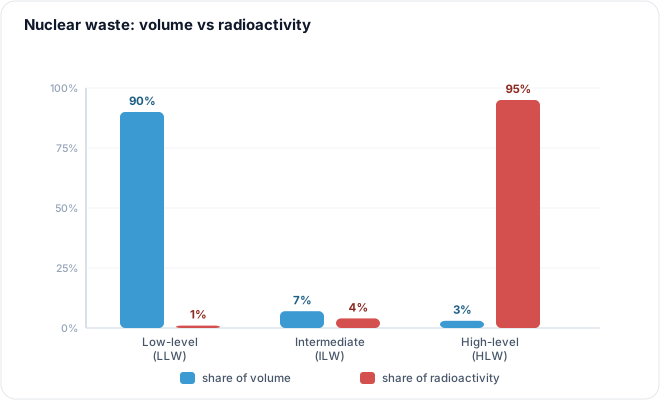
!Chart of nuclear waste volume versus radioactivity
Most waste by volume is barely radioactive; the highly radioactive part is tiny in volume.
Nuclear waste is not a single type of material but rather a category that includes various radioactive materials produced during nuclear power generation, medical procedures, research activities, and industrial applications. Understanding the different types of nuclear waste is essential for appreciating the real scope of the challenge and the effectiveness of current management approaches.
Low-Level Waste (LLW) comprises about 90% of all nuclear waste by volume but contains only about 1% of the total radioactivity [1]. This category includes items like protective clothing, medical gloves, cleaning materials, and tools that have been contaminated with small amounts of radioactive material. Most low-level waste is only slightly more radioactive than natural background levels and decays to safe levels within a few decades.
Intermediate-Level Waste (ILW) contains higher levels of radioactivity and may require shielding during handling and transport. This category includes reactor components, chemical sludges from reprocessing, and some medical waste. ILW represents about 7% of nuclear waste by volume and about 4% of total radioactivity [1].
High-Level Waste (HLW) includes used nuclear fuel and waste from reprocessing activities. While HLW represents only about 3% of nuclear waste by volume, it contains about 95% of the total radioactivity [1]. This is the category that receives the most attention and requires the most sophisticated management approaches.
The key insight is that the vast majority of nuclear waste—90% by volume—is low-level waste that poses minimal risks and can be managed using straightforward disposal methods. The small volume of high-level waste, while requiring more sophisticated management, is also entirely manageable using proven technologies.
One of the most striking facts about nuclear waste is how little of it exists compared to other industrial wastes. All of the used nuclear fuel produced by the U.S. nuclear energy industry over the last 60 years could fit on a football field at a depth of less than 10 yards [2]. This represents the waste from generating about 20% of America's electricity for six decades.
To put this in perspective, a typical coal plant produces more waste in a single day than a nuclear plant produces in a year. Coal plants generate millions of tons of ash, scrubber sludge, and other solid wastes annually, plus billions of tons of carbon dioxide that are released directly into the atmosphere. A nuclear plant of similar size produces about 20-30 tons of used fuel per year, all of which is carefully contained and managed [2].
The energy density of nuclear fuel explains this remarkable difference. A single uranium fuel pellet the size of a fingertip contains as much energy as a ton of coal [2]. This extraordinary energy density means that nuclear power produces vastly less waste per unit of energy generated than any other major electricity source.
Even counting every category of nuclear waste rather than used fuel alone, the volumes stay small. It is worth being clear about scope, since the famous "one football field" figure refers specifically to US commercial used fuel: low- and intermediate-level waste — contaminated gloves, filters, tools, decommissioned components — makes up the great majority of nuclear waste by volume and a tiny fraction of its radioactivity, and is disposed of in near-surface facilities that have operated routinely for decades. High-level waste is the small, hot, long-lived fraction that geological disposal is for.
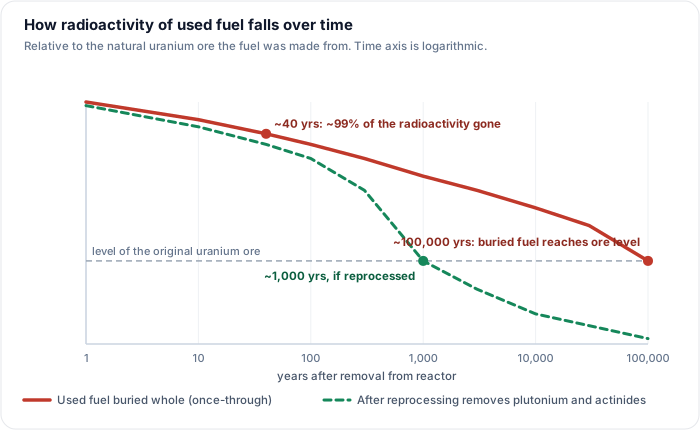
!Curve of used-fuel radioactivity falling over time
Radioactivity falls fast at first — roughly 99% is gone within about 40 years. The long tail is what disposal is designed for: buried whole, used fuel reaches the radioactivity of natural ore in around 100,000 years; reprocessed to remove plutonium and the minor actinides, in around 1,000.
Unlike chemical pollutants that remain toxic indefinitely, radioactive materials naturally decay over time, becoming less dangerous as they age. This fundamental property of radioactive materials means that nuclear waste becomes safer with time, unlike chemical wastes that maintain their toxicity forever.
The rate of radioactive decay is measured in half-lives—the time it takes for half of the radioactive atoms to decay. After 10 half-lives, less than 0.1% of the original radioactivity remains. Different radioactive isotopes have different half-lives, ranging from fractions of a second to millions of years.
Most of the radioactivity in used nuclear fuel comes from isotopes with relatively short half-lives. After about 40 years of storage, used fuel has lost roughly 99% of its initial radioactivity [1]. Within about 500 years the short-lived fission products responsible for most of the heat and radiation are essentially gone.
The long tail is the part that matters for disposal, and it is worth being precise about because the figure is often quoted wrongly. Fuel buried without reprocessing does not return to the radioactivity of the original uranium ore in a few hundred years. Because of the plutonium and minor actinides it contains, that takes on the order of 100,000 years — which is exactly why deep geological repositories are engineered and licensed against that timescale rather than a shorter one. Finland's regulator assessed Onkalo over a minimum of 100,000 years, with scenario modelling out to a million.
Reprocessing changes this fundamentally. Separate out the plutonium and actinides and burn them as fuel, and what remains decays to ore level in roughly a thousand years instead of a hundred thousand. Turning a 100,000-year problem into a 1,000-year one is the single strongest argument for recycling used fuel rather than burying it whole.
This natural decay process means that the most dangerous period for nuclear waste is actually the shortest. The isotopes that produce the most radiation decay quickly, while the long-lived isotopes that persist for thousands of years produce relatively little radiation. By the time nuclear waste has been stored for a few hundred years, it poses minimal risk to human health or the environment.
Used nuclear fuel is currently stored safely at reactor sites around the world using two proven methods: wet storage in specially designed pools and dry storage in robust concrete and steel containers.
Pool Storage involves placing used fuel assemblies in deep pools of water at reactor sites. The water provides both cooling and radiation shielding, allowing the fuel to be stored safely while the most radioactive isotopes decay. These storage pools are typically 40 feet deep, with the fuel stored under at least 20 feet of water that provides complete radiation shielding [3].
Pool storage has been used successfully for decades, with an outstanding safety record. The pools are constructed of reinforced concrete with stainless steel linings, designed to withstand earthquakes, floods, and other extreme events. Multiple backup systems ensure that cooling and water levels are maintained even during emergencies.
Dry Storage involves placing used fuel in specially designed containers that provide both radiation shielding and passive cooling through natural air circulation. These containers, called dry casks, are made of steel and concrete and are designed to last for decades without maintenance [3].
Dry storage has proven extremely reliable and safe. The containers are designed to withstand extreme weather, earthquakes, floods, and even terrorist attacks. They require no electricity or active cooling systems, relying instead on natural processes to maintain safe temperatures.
Both storage methods have been extensively tested and have operated for decades without harming anyone. No member of the public has been injured by stored used fuel anywhere in the world.
That is not the same as a perfect record, and the exception is worth stating because it is on the regulator's own website. Two spent-fuel pools at the Indian Point plant in New York leaked tritium and strontium into the groundwater beneath the site, detected in 2005 and monitored for years afterwards. Concentrations in the Hudson River stayed far below drinking-water limits and no drinking supply was affected, but the leaks were real, they took years to characterise, and the plant is now being decommissioned. The honest description of used-fuel storage is well-contained and closely monitored, not incapable of leaking — and a system that finds and publishes its own tritium traces is behaving exactly as it should.
While current storage methods are safe and effective, the long-term solution for high-level nuclear waste is deep geological disposal in specially designed underground repositories. This approach isolates radioactive materials from the human environment using multiple barriers that work together to prevent any release of radioactivity.
The Multi-Barrier Concept uses several independent barriers to contain radioactive materials:
This multi-barrier approach ensures that even if one barrier fails, the others continue to provide protection. The combination of engineered and natural barriers can isolate radioactive materials for the thousands of years needed for them to decay to safe levels.
Finland is about to be first: Finland's Onkalo repository, 400-450 metres down in granite bedrock at Eurajoki, is the furthest advanced disposal project in the world — and as of this writing it is weeks away from being licensed to operate, not yet operating.
The sequence matters, because it is the part usually reported wrongly. Posiva applied for its operating licence at the end of 2021. On 4 August 2026, Finland's Radiation and Nuclear Safety Authority, STUK, gave its favourable safety statement: the conditions of the Nuclear Energy Act are met and there is no obstacle to a licence running to 2070 [1]. The Ministry of Economic Affairs and Employment is preparing the licence proposal for a government decision in autumn 2026, and Posiva is aiming to begin disposal by the end of the year.
STUK's assessment examined repository performance over a minimum of 100,000 years, with scenario modelling extending to around a million. That is the review that had never been completed anywhere before, and completing it is the genuinely new thing: for the first time, a national safety regulator has examined a complete geological disposal case and concluded it works.
No spent fuel has yet been emplaced in a permanent repository anywhere in the world. Saying so plainly is better than the alternative, because the achievement stands without exaggeration — decades of characterisation, an independent regulator satisfied, and a start date measured in months.
International Progress: Many countries have made significant progress toward implementing deep geological disposal:
Used nuclear fuel is not actually "waste" in the traditional sense—it still contains about 95% of its original uranium plus valuable plutonium created during reactor operation. Several countries reprocess used fuel to recover these materials for reuse, dramatically reducing the volume and toxicity of waste requiring disposal.
The Reprocessing Process involves dissolving used fuel in acid and using chemical separation techniques to recover uranium and plutonium. The recovered materials can be fabricated into new fuel, while the remaining high-level waste is vitrified (turned into glass) for disposal.
France's Reprocessing Program is the world's largest commercial reprocessing operation, handling used fuel from France and several other countries. The La Hague facility has operated safely for decades, recycling thousands of tons of used fuel and reducing waste volumes by about 85% [4].
Benefits of Reprocessing:
Advanced Reprocessing Technologies under development promise even greater benefits, including the ability to recycle all actinide elements and dramatically reduce the long-term toxicity of nuclear waste.
When nuclear waste is compared to wastes from other energy sources and industrial activities, its advantages become clear:
Coal Waste: Coal plants produce millions of tons of ash containing toxic heavy metals, radioactive materials, and carcinogenic compounds. Coal ash is stored in huge ponds and landfills that can leak into groundwater and are vulnerable to catastrophic failures. Unlike nuclear waste, coal ash remains toxic forever and is produced in vastly larger quantities.
Chemical Industry Waste: The chemical industry produces millions of tons of toxic waste annually, including carcinogens, mutagens, and persistent organic pollutants that remain dangerous indefinitely. Much of this waste is incinerated, releasing pollutants into the air, or stored in facilities with less stringent containment than nuclear waste repositories.
Mining Waste: Metal mining produces billions of tons of waste rock and tailings that can contain toxic heavy metals and acid-generating materials. These wastes are typically stored in large surface impoundments that can fail catastrophically, as demonstrated by numerous tailings dam failures worldwide.
Electronic Waste: Electronic devices contain toxic materials including lead, mercury, and cadmium that remain hazardous indefinitely. Most electronic waste is not properly managed, ending up in landfills or being exported to developing countries where it causes environmental and health problems.
Nuclear waste stands out for its small volume, decreasing toxicity over time, and comprehensive management systems that far exceed those used for other industrial wastes.
Nuclear waste must sometimes be transported between facilities, and this transportation has an outstanding safety record spanning decades of operations worldwide.
Transportation Containers are designed to withstand extreme accidents without releasing radioactive materials. These containers must pass rigorous tests including:
Safety Record: Thousands of shipments of used fuel have been made worldwide without a cask releasing its contents, including in accidents severe enough to destroy the vehicle carrying it. Certification requires a cask to survive, in sequence, a 30-foot drop onto an unyielding surface, a drop onto a steel spike, thirty minutes engulfed in an 800 °C fire, and eight hours under water — and regulators have crash-tested casks against walls and locomotives to demonstrate it.
Regulatory Oversight: Nuclear material transportation is subject to strict regulations and oversight by national and international authorities. Shipments are tracked continuously, and emergency response plans are in place for any unlikely accidents.
Nuclear waste management systems are designed to protect both public health and the environment, with safety standards that are more stringent than those applied to other industrial wastes.
Radiation Protection Standards for nuclear waste management are based on the principle of keeping radiation exposures "as low as reasonably achievable" (ALARA). These standards ensure that any potential exposures from nuclear waste management are far below levels that could cause health effects.
Environmental Monitoring around nuclear facilities includes continuous monitoring of air, water, soil, and vegetation for any signs of radioactive contamination. This monitoring has consistently shown that nuclear waste storage and disposal facilities have no measurable impact on environmental radioactivity levels.
Long-Term Safety Assessments for disposal facilities use sophisticated computer models to predict the behaviour of nuclear waste over thousands of years. These assessments consider various scenarios including climate change, geological processes, and potential human intrusion to ensure that disposal systems remain safe over the required timeframes.
Several persistent myths about nuclear waste continue to influence public opinion despite being contradicted by scientific evidence:
Myth: Nuclear waste remains dangerous for millions of years Reality: While some isotopes have very long half-lives, they produce very little radiation. The most dangerous isotopes decay quickly, and after a few hundred years, nuclear waste is no more radioactive than the original uranium ore.
Myth: Nuclear waste will leak and contaminate groundwater Reality: Repositories are designed on the assumption that individual barriers eventually will fail, which is why there are several of them in series. Safety cases model canister corrosion, groundwater flow and human intrusion over 100,000 years and calculate the resulting dose; Finland's assessment found it stays far below natural background even in pessimistic scenarios. The claim is not that nothing can ever move, but that the amount which could, at the rate it could, through hundreds of metres of low-permeability rock, is too small to matter.
Myth: Nuclear waste can explode or cause nuclear explosions Reality: Nuclear waste cannot explode or cause nuclear reactions. Used nuclear fuel has too low a concentration of fissile material to sustain a chain reaction, and the waste is in a chemically stable form.
Myth: There is no solution for nuclear waste Reality: There is a solution, it has been through a full regulatory safety review, and it is about to be used. Finland's Onkalo repository cleared its safety assessment in August 2026 and awaits a government licence; Sweden is building; Canada chose its site in 2024. What is true is that no repository is yet accepting fuel, and that the United States has stalled for political rather than technical reasons. "Solved on paper, being built, not yet finished" is the accurate answer — and it is a far better answer than the question implies.
Myth: Nuclear waste is uniquely dangerous compared to other industrial wastes Reality: Nuclear waste is actually better managed and poses lower risks than many other industrial wastes that receive less attention.
Nuclear waste management costs are included in the price of nuclear electricity through dedicated funds that accumulate money for waste management activities. This "polluter pays" approach ensures that waste management costs are internalized rather than passed on to future generations.
Waste Management Funding in most countries comes from fees paid by nuclear utilities based on their electricity generation. These funds accumulate over the operating life of nuclear plants and provide the resources needed for long-term waste management.
Cost Comparisons show that nuclear waste management costs are a small fraction of total electricity costs—typically less than 1% of the consumer electricity price. This compares favorably with the external costs of fossil fuel waste management, which are often not internalized in electricity prices.
Repository Costs for deep geological disposal are substantial but manageable. The total cost of a repository is typically spread over decades of operation and shared among multiple nuclear utilities, making the cost per kilowatt-hour very small.
Ongoing research and development are creating new technologies that could further improve nuclear waste management:
Advanced Reactor Technologies can consume existing nuclear waste as fuel, dramatically reducing the volume and toxicity of waste requiring disposal. Fast reactors and molten salt reactors can burn actinides and other long-lived isotopes, essentially eliminating the long-term waste problem.
Partitioning and Transmutation technologies can separate long-lived isotopes from nuclear waste and transform them into shorter-lived or stable isotopes using accelerators or advanced reactors.
Improved Waste Forms including advanced ceramics and metal alloys can provide even better containment of radioactive materials over long time periods.
Enhanced Repository Designs incorporate new materials and concepts that could improve the performance and reduce the costs of deep geological disposal.
Nuclear waste management benefits from extensive international cooperation and standardized approaches:
International Atomic Energy Agency (IAEA) provides safety standards, technical guidance, and peer review services for nuclear waste management programs worldwide.
Joint Convention on the Safety of Spent Fuel Management and Radioactive Waste Management establishes international legal obligations for safe waste management and provides a framework for international cooperation.
Multinational Repositories are being considered as a way to share costs and expertise for nuclear waste disposal, particularly for countries with small nuclear programs.
Research Collaboration enables countries to share the costs and benefits of waste management research and development.
Nuclear waste management continues to evolve with new technologies and approaches that promise even better solutions:
Geological repository implementation should accelerate once Finland is operating, because the hardest part has been regulatory precedent rather than engineering — Sweden and Canada are following the same design and the same consent-based siting model.
Waste Recycling will expand as more countries develop reprocessing capabilities and advanced reactor technologies that can consume existing waste.
International Solutions may emerge as countries cooperate on waste management challenges and share facilities and expertise.
Advanced Technologies including artificial intelligence, robotics, and new materials will improve the safety, efficiency, and cost-effectiveness of waste management operations.
The scientific evidence is clear: nuclear waste is not the insurmountable problem that critics claim. It is a manageable challenge with proven solutions that protect both human health and the environment. The small volume of nuclear waste, its decreasing radioactivity over time, and the multiple barriers used in disposal systems combine to create a waste management approach that is safer and more effective than those used for other industrial wastes.
Current storage is safe and closely monitored, holding used fuel securely while permanent disposal facilities are finished. Deep geological disposal is the permanent answer, and Finland has now taken it through a complete regulatory safety review — the step nobody had completed before.
The myths and misconceptions surrounding nuclear waste have created public fears that are not supported by scientific evidence. Nuclear waste management represents one of the most successful examples of industrial waste handling, with comprehensive cradle-to-grave management that ensures protection of current and future generations.
As the world seeks clean energy solutions to address climate change, nuclear waste should not be seen as a barrier to nuclear power development. Instead, it should be recognised as a manageable aspect of a clean energy technology that offers enormous benefits for human health, environmental protection, and climate stability.
The truth about nuclear waste is narrower than the slogan and more useful. It is solvable, it is very nearly solved, and it has never hurt anybody. What it does not yet have is a finished permanent home — Finland is months away from the first, Sweden is building, Canada has chosen its ground, and the United States has spent fifteen years not deciding. That last one is a political failure, not a scientific one, and it is worth naming as such rather than glossing over.
The real question is not whether used fuel can be managed safely; it is being managed safely today, in plain sight, counted to the gram. The question is whether fear of the one waste stream we track completely will keep us burning the ones we don't.
Nuclear waste management is a success story that deserves recognition, not fear. The comprehensive, multi-barrier approach to nuclear waste disposal provides a model for how industrial wastes should be managed, protecting both current and future generations while enabling the benefits of clean nuclear energy.
[1] World Nuclear Association. "Storage and Disposal of Radioactive Waste." April 30, 2024. https://world-nuclear.org/information-library/nuclear-fuel-cycle/nuclear-waste/storage-and-disposal-of-radioactive-waste
[2] U.S. Department of Energy. "3 Reasons Why Nuclear is Clean and Sustainable." March 31, 2021. https://www.energy.gov/ne/articles/3-reasons-why-nuclear-clean-and-sustainable
[3] U.S. Nuclear Regulatory Commission. "Storage of Spent Nuclear Fuel." November 2023. https://www.nrc.gov/waste/spent-fuel-storage.html
[4] World Nuclear Association. "Processing of Used Nuclear Fuel." January 2024. https://world-nuclear.org/information-library/nuclear-fuel-cycle/fuel-recycling/processing-of-used-nuclear-fuel